These notes were written by the person who submitted this item. Appraiser.AI has not verified them, and the AI's identification and estimate may rely on them.
AI Estimated Value
Not an official valuation
$400-600
AI estimate as of October 13, 2025 · verify with a professional before acting
AI-Generated · Verify before acting
Everything on this page is generated by AI for informational purposes only. AI can make mistakes — the AI may misidentify items or misattribute them (artist, maker, brand, designer, origin, era). This is not an official valuation and should not be used for insurance, sale, tax, estate, legal, or lending purposes — or any decision requiring a certified appraisal. It is not an authoritative claim about any person, brand, or rights holder — do not share or rely on it as a factual statement about a third party. Always consult qualified professionals before making financial decisions.
This analysis also relies on unverified notes provided by the user, which may be incomplete or inaccurate and could affect the result.
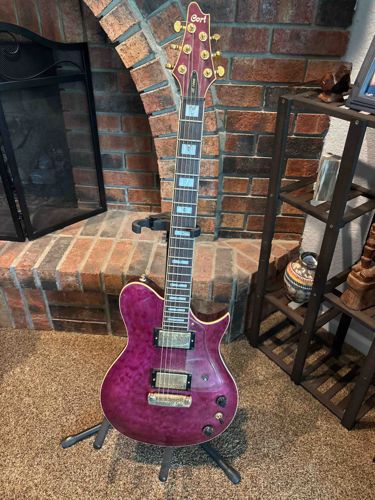
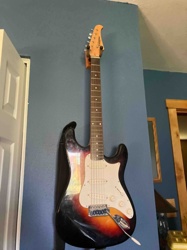
This is a Cort CL1000 electric guitar, featuring a stunning translucent purple finish that reveals a flamed maple top. The body shape is a single-cutaway design, reminiscent of classic Les Paul styles but with a slightly sharper horn. The hardware, including the tuners, bridge, and pickup covers, appears to be gold-finished, contrasting elegantly with the deep purple body. The guitar is equipped with two humbucking pickups, suggesting a versatility for various musical genres. The controls consist of four knobs (likely two volume and two tone) and a three-way toggle switch for pickup selection, all mounted on the body. A distinctive feature is the binding around the body, fretboard, and headstock, which is an off-white or cream color, enhancing the instrument's visual appeal. The neck features a fretboard with large, rectangular block inlays, possibly made of mother-of-pearl or a similar pearloid material, which are characteristic of many high-end guitars. The headstock is also purple with gold hardware and bears the 'Cort' logo in white script. The frets appear to be in good condition, and the overall finish, while vibrant, might show minor play wear or superficial scratches not discernible from the image. The guitar is currently resting on a black, collapsible guitar stand. The construction indicates a set-neck design or possibly neck-through, which contributes to sustain and resonance. The CL1000 model is part of Cort's Classic Rock Series, aimed at delivering vintage tones and aesthetics with modern playability. Given its features and apparent condition, it represents a well-crafted instrument designed for performance.
AI Appraisal Report
I have examined the provided image and information for this Cort CL1000 Electric Guitar. Visually, the guitar presents as authentic to the Cort CL1000 model, characterized by its single-cutaway body, block inlays, gold hardware, and striking translucent purple flamed maple top. The ‘Cort’ logo on the headstock further supports its authenticity. Condition appears good to very good, with frets seeming substantial and the finish vibrant, though I cannot ascertain minor play wear or superficial scratches without closer physical inspection. The binding on the body, fretboard, and headstock is intact and visually appealing.
Cort CL1000 guitars are part of their Classic Rock Series, known for offering value-driven instruments with good playability and aesthetics inspired by iconic designs. Market conditions for these models are generally stable, catering to players seeking quality entry to mid-level instruments. While not considered rare, models with a flamed maple top and unique finishes like this purple tend to garner slightly more interest. Demand is moderate, driven by gigging musicians and enthusiasts.
Factors impacting value include the visually good condition, attractive finish, and functional hardware. The set-neck construction also adds to its appeal. However, without in-person examination, I cannot verify the exact fret wear, electronics functionality, neck straightness, or structural integrity. Authentication from an image alone is limited; a physical inspection would be required to confirm all components are original, no hidden repairs exist, and to fully assess tonal qualities and playability. Provenance documentation, such as original purchase receipts or service history, would further solidify its value and history.