AI estimate as of September 28, 2025 · verify with a professional before acting
AI-Generated · Verify before acting
Everything on this page is generated by AI for informational purposes only. AI can make mistakes — the AI may misidentify items or misattribute them (artist, maker, brand, designer, origin, era). This is not an official valuation and should not be used for insurance, sale, tax, estate, legal, or lending purposes — or any decision requiring a certified appraisal. It is not an authoritative claim about any person, brand, or rights holder — do not share or rely on it as a factual statement about a third party. Always consult qualified professionals before making financial decisions.
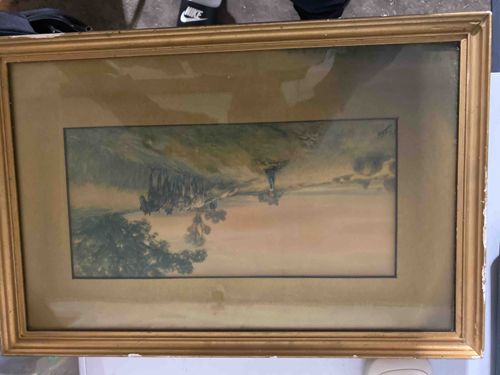
This item is a framed landscape print, likely a reproduction of a painting or watercolor, enclosed within a gold-tone wooden frame. The print itself depicts a panoramic pastoral scene with rolling hills or mountains in the background, a body of water or valley in the midground, and prominent trees in the foreground. The color palette of the print primarily consists of muted greens, blues, and earthy tones for the landscape, with a soft, warm hue, possibly representing a hazy sky or dusk, near the horizon. The printing technique appears to be a color lithograph or similar reproduction process, characterized by a slightly soft focus and blended colors, typical of early to mid-20th-century art prints. The print is horizontally oriented. The frame is constructed from wood, featuring a gesso and gold leaf or gold paint finish. It has a classic, somewhat ornate profile with multiple stepped and coved elements, typical of frames from the Victorian or Edwardian eras, or reproductions from the mid-20th century. The gold finish shows significant wear, with areas of abrasion, chipping, and loss, particularly along the outer and inner edges, revealing the darker substrate beneath. The matte surrounding the print is a light, neutral color, possibly cream or light beige, and also shows signs of age, including discoloration, spotting, and possibly foxing, which indicates moisture exposure or age-related degradation of the paper. There are visible reflections on the glass covering, suggesting it is glazed. The overall condition suggests that this piece has been displayed for a considerable time and has experienced some environmental exposure. The craftsmanship of the frame is decent, though the wear indicates it is not a recent piece. The print itself seems to be in acceptable condition underneath the glass, though its true state can't be fully assessed due to the reflections and age of the matte.
AI Appraisal Report
Upon visual examination of this framed landscape print, I note its horizontal orientation within a gold-tone wooden frame. The print itself appears to be a color lithograph or similar reproduction from the early to mid-20th century, depicting a pastoral scene with muted greens, blues, and earthy tones. The frame, while having a classic, ornate profile suggestive of Victorian or Edwardian design, is likely a reproduction from the mid-20th century, given its materials and finish. Its significant wear, including chipping and loss of gesso and gold, indicates considerable age and environmental exposure. The matte is discolored and shows spotting, consistent with foxing, suggesting moisture or age-related paper degradation. The presence of glass, unfortunately, introduces reflections that hinder a full assessment of the print's condition. While the print seems acceptable underneath, its true state and any potential damage (tears, creases, fading) cannot be definitively determined without physical inspection. Authenticity as an original artwork is highly unlikely; this is a decorative print. Market comparables for similar vintage decorative landscape prints, especially those with visible condition issues in the frame and matte, typically range from low to moderate. Demand for such items is generally low, unless tied to a known artist or specific collectible series, neither of which is evident here. The primary value is decorative. Without an in-person examination, I cannot assess the print's full condition, confirm the reproduction technique, or inspect for artist signatures or edition numbers on the print itself. Factors significantly impacting value include the obvious wear to the frame and matte, and the print's status as a decorative reproduction. Physical inspection would allow for a precise condition report and potential identification of the print's origin or publisher, which could modestly influence value.