These notes were written by the person who submitted this item. Appraiser.AI has not verified them, and the AI's identification and estimate may rely on them.
AI Estimated Value
Not an official valuation
$100-150
AI estimate as of June 24, 2025 · verify with a professional before acting
AI-Generated · Verify before acting
Everything on this page is generated by AI for informational purposes only. AI can make mistakes — the AI may misidentify items or misattribute them (artist, maker, brand, designer, origin, era). This is not an official valuation and should not be used for insurance, sale, tax, estate, legal, or lending purposes — or any decision requiring a certified appraisal. It is not an authoritative claim about any person, brand, or rights holder — do not share or rely on it as a factual statement about a third party. Always consult qualified professionals before making financial decisions.
This analysis also relies on unverified notes provided by the user, which may be incomplete or inaccurate and could affect the result.
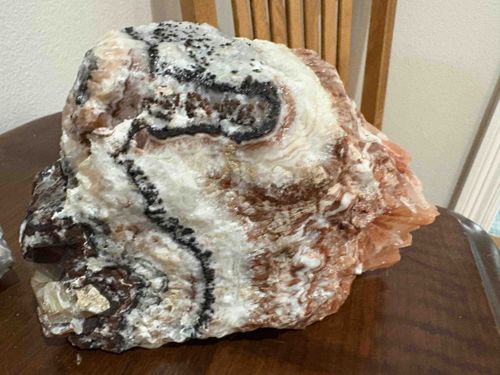
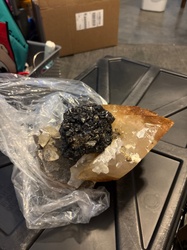
This item is a natural mineral specimen, likely a large chunk of rough banded calcite or aragonite, exhibiting a striking array of colors and patterns. The overall dimensions are approximately 7 inches by 5 1/2 inches, indicating a substantial size for a display piece. Its physical characteristics include a dominant white to off-white matrix intertwined with rich rusty red, orange, and brown tones. Prominent black lines, appearing as veins or inclusions, traverse parts of the white sections, creating a stark contrast and intricate artistic designs. The texture appears rough and unpolished, consistent with a natural, unworked mineral formation. Some areas show a crystalline structure, particularly the more translucent, lighter-colored sections, suggesting a growth pattern characteristic of these minerals. The surface exhibits natural variations and irregularities, including small fissures and indentations, which are typical for raw mineral specimens rather than signs of damage. There are no discernible manufacturing details such as maker's marks or signatures, which is expected for a natural mineral. Its estimated age is geological, having formed over millennia. The piece serves as a decorative object, showcasing the beauty of natural geological processes. The quality is primarily defined by the vibrancy of its colors and the complexity of its banding, which are both highly appealing in this specimen. It appears to be in its natural state with good preservation, exhibiting a natural patina without any visible wear, repairs, or significant damage from handling.
AI Appraisal Report
Based on my visual examination of the provided image and description, this Banded Calcite/Aragonite Mineral Specimen, measuring approximately 7 x 5.5 inches, presents as a natural and aesthetically striking geological formation. Its condition appears excellent, exhibiting typical rough, unpolished textures, vibrant natural coloration with distinct white, rusty red, orange, brown, and prominent black veining, and no visible signs of damage, wear, or repair. The complexity of its banding and color palette significantly enhance its decorative appeal and, consequently, its market desirability. In assessing market conditions, similar-sized, visually appealing natural calcite or aragonite specimens with strong banding and varied colors typically command prices within the mid-range for decorative minerals. The demand for unique, unpolished natural specimens remains steady among collectors and interior decorators seeking organic sculptural elements. While mineral specimens are not inherently rare in a broad sense, those with exceptional coloration and pattern configurations like this one are less common. Factors significantly impacting its value include its substantial size, the attractive color contrast, and the intricate banding. The absence of manufacturing marks is expected and does not impact authenticity. It's crucial to state that full authentication of mineral composition (calcite vs. aragonite, and specific inclusions causing coloration) and definitive origin would require an in-person examination, potentially including streak tests, Mohs hardness testing, and acid tests for precise mineral identification. Furthermore, while the visual evidence strongly suggests authenticity as a natural specimen, provenance documentation, if available, could further corroborate its history. Without physical inspection, the precise crystalline structure and any subtle treatments (e.g., polishing that might alter reflectivity) cannot be definitively ruled out, though the current appearance strongly suggests an unworked, natural state.