AI estimate as of August 10, 2025 · verify with a professional before acting
AI-Generated · Verify before acting
Everything on this page is generated by AI for informational purposes only. AI can make mistakes — the AI may misidentify items or misattribute them (artist, maker, brand, designer, origin, era). This is not an official valuation and should not be used for insurance, sale, tax, estate, legal, or lending purposes — or any decision requiring a certified appraisal. It is not an authoritative claim about any person, brand, or rights holder — do not share or rely on it as a factual statement about a third party. Always consult qualified professionals before making financial decisions.
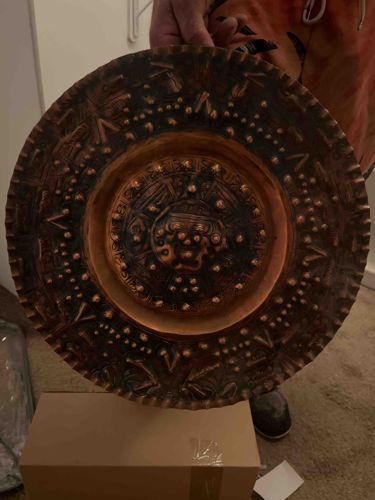
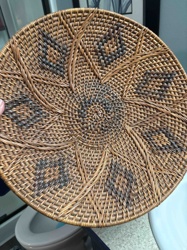
This appears to be a large, circular decorative plate or wall hanging, possibly crafted from cast metal or a heavy resin designed to mimic metal, given its substantial appearance and deep relief. The primary color is a dark, oxidized copper or bronze tone, with lighter, burnished highlights on the raised areas that suggest age and handling, or perhaps an applied patina for an antiqued effect. Its construction boasts significant three-dimensional relief, particularly in the central motif and the surrounding bands. The central design is highly intricate, resembling an Aztec or Mayan calendar stone, with stylized glyphs and a prominent face or mask at its core, indicative of Mesoamerican cultural influence. Surrounding this central medallion, there are concentric rings of varying decorative elements: some feature geometric patterns, others small, raised 'dots' or hemispherical bosses, and an outer ring displays angular, stylized glyphs or symbols, possibly depicting birds or abstract shapes. The edge of the plate has a serrated or textured finish, adding to its rugged, artisanal aesthetic. While the exact material is not definitively discernible from the image, the uniformity of color and texture, along with the detailed casting, points towards either a molded resin finished to look like metal or a cast metal piece. There are no visible condition issues such as major cracks or chips, but the overall patina suggests a naturally aged appearance or intentional distressing. The craftsmanship appears to be of good quality, with clear definition in the raised patterns. It likely dates from the mid-20th century onwards, created as a decorative piece rather than an ancient artifact.
AI Appraisal Report
Upon my virtual examination of this large, circular decorative plate or wall hanging, I assess its condition as very good for a decorative item of its type. The intentional antiqued finish, characterized by dark, oxidized tones and burnished highlights, appears consistent throughout, with no visible major cracks, chips, or undue wear that would detract from its aesthetic appeal. The clear definition of the intricate, raised patterns, particularly the central Mesoamerican-style motif, suggests good quality casting, whether it be from resin or metal.
Regarding authenticity, this piece is clearly a decorative reproduction inspired by ancient Mesoamerican calendrical designs, rather than an artifact itself. Its consistency in finish and the nature of the relief point strongly towards a manufactured decorative item, likely dating from the mid-20th century to contemporary production. Without physical inspection, I cannot definitively ascertain the material, though it strongly resembles cast resin with a metallic finish due to the uniform color and detailed, yet perhaps 'softened,' edges often seen in resin casts. If it were a heavier cast metal, its value would be slightly higher.
Market conditions for such decorative pieces are steady. They appeal to collectors of ethnographic-inspired decor or individuals seeking unique wall art. Comparables would include similar large-scale, culturally-inspired wall plaques in resin or composite materials. Demand is moderate, primarily from the home decor market, rather than antique or fine art collectors. Rarity is low, as pieces of this generalized style were mass-produced. The primary factors impacting value are its large size, intricate design, and good visual condition. The limitation here is the inability to confirm material (resin vs. metal) and weight, which significantly influence handling and perceived quality. Full authentication of material would require in-person examination, including a scratch test or weight assessment. Provenance is irrelevant for a modern decorative piece of this nature.
Considering these factors, particularly its decorative nature and likely material, my appraisal reflects its value within the secondary market for home decor items.