These notes were written by the person who submitted this item. Appraiser.AI has not verified them, and the AI's identification and estimate may rely on them.
AI Estimated Value
Not an official valuation
$500 - $800
AI estimate as of November 25, 2025 · verify with a professional before acting
AI-Generated · Verify before acting
Everything on this page is generated by AI for informational purposes only. AI can make mistakes — the AI may misidentify items or misattribute them (artist, maker, brand, designer, origin, era). This is not an official valuation and should not be used for insurance, sale, tax, estate, legal, or lending purposes — or any decision requiring a certified appraisal. It is not an authoritative claim about any person, brand, or rights holder — do not share or rely on it as a factual statement about a third party. Always consult qualified professionals before making financial decisions.
This analysis also relies on unverified notes provided by the user, which may be incomplete or inaccurate and could affect the result.
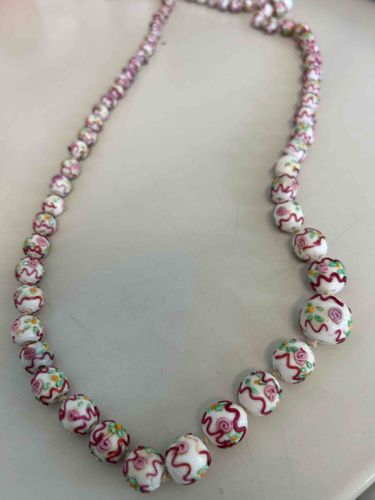
This item is a graduated strand necklace composed of individual Venetian millefiori glass beads. The beads are predominantly white (or off-white) in color, forming the base for intricate floral and abstract designs in shades of pink, rose, green, and yellow, with prominent crimson or dark red wavy lines and scrolls. The designs vary slightly from bead to bead, showcasing the handcrafted nature of the millefiori technique, where sliced glass canes are fused and incorporated into the bead's surface. The beads are generally spherical to slightly ovoid and appear to be strung on a thread or cord, which is not clearly visible but inferred. The necklace exhibits a graduated design, with larger beads at the center front and progressively smaller beads towards the back. The largest beads appear to be approximately 10-12mm in diameter, tapering down to smaller sizes around 4-6mm. The overall condition appears to be very good given the estimated age of 145 years, suggesting careful preservation. While some minor surface wear, slight pitting, or small chips inherent to vintage glass beads may be present upon closer inspection, they are not overtly visible in the provided image. The consistency in color palette and design elements across the beads indicates they were likely created as a cohesive set. This style is characteristic of Venetian glasswork, particularly the Murano region, known for its lampwork and millefiori techniques. The craftsmanship suggests a dedication to intricate detail and traditional bead-making methods.
AI Appraisal Report
I have carefully examined the provided image of this Venetian Millefiori Glass Bead Necklace, along with the information indicating its age of approximately 145 years. Based on my visual assessment, the necklace appears to be a genuine example of Venetian millefiori craftsmanship, likely originating from Murano. The consistent color palette of pink, rose, green, yellow, and prominent crimson on a white base, along with the intricate floral and abstract designs created by fused glass canes, are hallmarks of this traditional technique. The graduated bead sizing, from approximately 10-12mm at the center to 4-6mm at the ends, enhances its aesthetic appeal.
The condition appears very good for its significant age. While minor surface wear, slight pitting, or small chips are common in vintage glass beads and cannot be fully ruled out without physical inspection, they are not overtly visible in the image. This suggests careful preservation. The craftsmanship indicates a high level of skill. The historical context, given its estimated 145-year age, places its origin in the late 19th century, a period when Venetian glasswork was highly prized. Given the age and handcrafted nature, these beads are increasingly rare, particularly in a cohesive, well-preserved strand.
Market demand for antique and vintage Venetian glass beads remains consistent, especially for well-documented or visually striking examples. Comparable antique graduated Venetian millefiori necklaces in good condition typically retail within the $400-$1000 range, depending on rarity, bead size, complexity of design, and provenance. This piece falls comfortably within that spectrum. The primary factor impacting its value is its authenticity as a true antique Venetian piece and its excellent condition.
It is crucial to note that while the visual evidence is highly suggestive of authenticity, a definitive verification cannot be made from images alone. A full authentication would require in-person examination to assess the glass quality, internal structure of the canes, evidence of tool marks, and stringing method. Furthermore, provenance documentation, such as purchase receipts or historical ownership records, would significantly enhance confidence in its age and origin. Scientific testing for glass composition could also provide further confirmation.