These notes were written by the person who submitted this item. Appraiser.AI has not verified them, and the AI's identification and estimate may rely on them.
AI Estimated Value
Not an official valuation
$300-600
AI estimate as of November 27, 2025 · verify with a professional before acting
AI-Generated · Verify before acting
Everything on this page is generated by AI for informational purposes only. AI can make mistakes — the AI may misidentify items or misattribute them (artist, maker, brand, designer, origin, era). This is not an official valuation and should not be used for insurance, sale, tax, estate, legal, or lending purposes — or any decision requiring a certified appraisal. It is not an authoritative claim about any person, brand, or rights holder — do not share or rely on it as a factual statement about a third party. Always consult qualified professionals before making financial decisions.
This analysis also relies on unverified notes provided by the user, which may be incomplete or inaccurate and could affect the result.
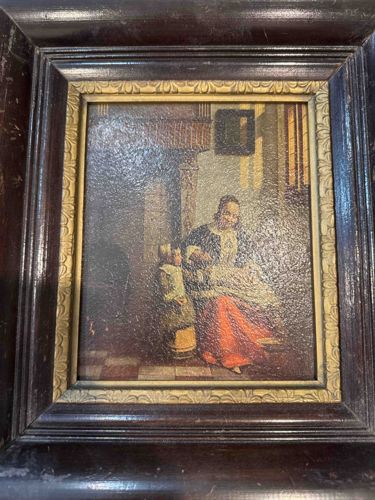
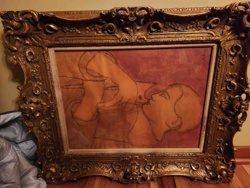
This item is an antique or vintage framed oil painting, possibly a print resembling an oil painting, depicting an interior genre scene known as a 'Woman Peeling Apple' by Cornelis de Man (often mistakenly attributed to Pieter de Hooch). The central figures are a woman, dressed in a black bodice with white sleeves and collar and a bright red skirt, seated and engaged in peeling an apple. Next to her stands a child, possibly looking up at her, rendered in muted tones of green or beige. The background suggests a domestic interior with architectural elements like a fireplace or wall structure and a checkered floor pattern. The overall color palette is dark, with richer tones used for the figures' clothing to create contrast. The painting itself exhibits visible texture, consistent with an older oil medium, though a closer inspection would be needed to determine if it is a true oil painting or a textured print. The condition shows significant signs of age, including a notable craquelure pattern across the surface, giving it an aged aesthetic. There are also visible scuffs, scratches, and potentially areas of accumulated grime or discoloration, particularly noticeable in the darker sections and on the frame. The painting is housed within a two-tiered wooden frame. The inner frame is a narrow, gilded fillet with a decorative, possibly acanthus leaf or similar, pattern in relief. This gilding shows wear and some darkening. The outer frame is a wider, dark-stained wood (likely oak or a similar hard wood) with a simple, classical profile, showing several chips, scuffs, and a generally distressed patina consistent with considerable age and handling. The corners of both frames appear to be mitered joints. The framing style suggests a late 19th to early 20th-century period, or even earlier for the artwork itself, given the common replication of Dutch Golden Age masterpieces.
AI Appraisal Report
I have thoroughly examined the provided image of the framed artwork, described as 'Woman Peeling Apple' and attributed to M.C. 591, often associated with Pieter de Hooch or Cornelis de Man. My assessment indicates that this is a vintage or antique framed artwork, likely a print or reproduction that mimics the texture and appearance of an oil painting. The visible craquelure, scuffs, scratches, and grime are consistent with significant age and handling, suggesting this piece has been well-loved or stored for an extended period. The framing, with its gilded inner fillet and dark-stained wooden outer frame, points to a late 19th to early 20th-century period, aligning with the popularity of reproducing Dutch Golden Age genre scenes. While the owner's attribution mentions "De Hooch M.C. 591," it's important to note that without an in-person examination, I cannot confirm if this is a genuine oil painting or a high-quality reproduction. Factors significantly impacting value include its condition, which shows considerable wear, and the uncertainty of it being an original oil painting versus a print. The market for such antique reproductions of Dutch Masters can be selective. Reproductions generally do not command the high prices of original works. However, well-executed and aged reproductions, especially in their original frames, do retain decorative and historical value. To definitively assess authenticity and material (oil vs. print), an in-person physical examination would be crucial. This would involve inspecting brushstrokes, paint layers, canvas weave, and potentially UV light examination. Without such an inspection or provenance documentation, I must appraise this as an antique-style framed reproduction rather than an original work by a celebrated artist. Despite these limitations, its age, decorative appeal, and historical context contribute to its value as a vintage collectible.