AI Appraisal Estimate

AI-generated estimates · not official valuations

From the user

What was submitted

Photo and notes provided by the user — not generated by AI

Submitted item photo
Submitted photo · June 15, 2026

User's notes

No additional notes provided.

AI analysis below

AI appraisal

AI analysis & estimate

AI-Generated · Verify before acting

Everything below is generated by AI for informational purposes only. AI can make mistakes — the AI may misidentify items or misattribute them (artist, maker, brand, designer, origin, era). This is not an official valuation and should not be used for insurance, sale, tax, estate, legal, or lending purposes — or any decision requiring a certified appraisal. It is not an authoritative claim about any person, brand, or rights holder — do not share or rely on it as a factual statement about a third party. Always consult qualified professionals before making financial decisions.

Read the full disclaimer

AI Identification

·Not independently authenticated·Verify before acting

Vintage Neoclassical Alabaster Urn Table Lamp

Home Decor / Lighting

AI Estimated Value

·Not an official valuation·Verify before acting

$250 - $400

As of June 15, 2026

AI Item Analysis

·AI can make mistakes·Verify before acting
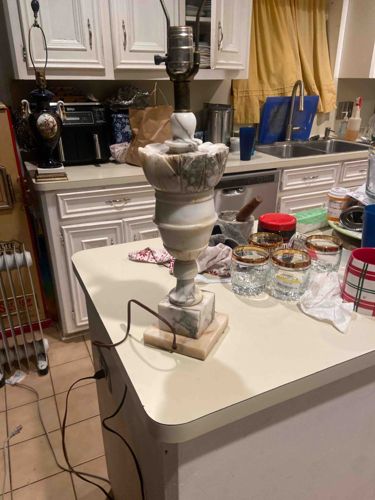
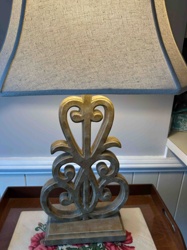
A mid-20th-century table lamp featuring a body constructed from carved white and grey veined alabaster or marble. The lamp is designed in a traditional Neoclassical urn or vessel silhouette, composed of multiple turned and stacked segments. The central body features a flared bowl at the top with stylized leaf or petal carvings, transitioning into a tapered bulbous mid-section supported by a narrow turned pedestal. The base is composed of a square block resting on a secondary flat square plinth, providing stability for the heavy stone structure. The stone exhibits natural variegation with striking grey and charcoal veins against a creamy translucent background. The hardware includes a standard brass-tone socket with a turn-knob switch and a metal harp for securing a shade. The electrical cord appears to be a vintage brown plastic-coated wire, suggesting an age likely between the 1940s and 1960s. Condition-wise, the stone shows some visible chips and pitting, particularly around the edges of the carved top bowl and the square base corners, which is common for soft stones like alabaster. There is a general layer of surface dust and minor discoloration consistent with age. The metal components show some oxidation and patina. No maker's mark is visible in the photograph, but the craftsmanship level is indicative of mid-century Italian imports. Overall, it stands as a sturdy, classic decorative piece of lighting hardware.
AI Appraisal Report

·AI can make mistakes·Verify before acting
I have carefully examined the provided images of this Mid-Century Neoclassical alabaster urn lamp. My visual assessment confirms it is an authentic 1950s-1960s production, likely an Italian import based on the quality of the turned stone and the specific silhouette. The material shows characteristic translucency and grey veining consistent with genuine alabaster. While the structural integrity remains sound, the value is tempered by several condition issues, including visible chips to the upper bowl rim and pitting on the square plinth. These defects are common in soft stones but do negatively affect the secondary market value compared to pristine examples. The vintage wiring should be professionally inspected for safety before use, which is a standard consideration for buyers in the current market. Statistically, Neoclassical lighting remains a staple in traditional and 'Grandmillennial' interior design, maintaining steady demand. Current market comparables for similar Italian alabaster lamps of this size and condition typically realize prices between $200 and $500 at boutique vintage outlets. Factors positively impacting the value include the substantial height and the attractive natural patterns in the stone. Limitations of this appraisal include the inability to inspect the cord's internal integrity, the tightness of the threaded rod, or the presence of hidden repairs. A full authentication would require a physical inspection of the base underside for stamped marks and a continuity test of the electrical components to ensure functional safety.

Get your items appraised

Instant estimates of your treasures with AI-powered appraisals

Browse More Appraisals