AI estimate as of July 21, 2025 · verify with a professional before acting
AI-Generated · Verify before acting
Everything on this page is generated by AI for informational purposes only. AI can make mistakes — the AI may misidentify items or misattribute them (artist, maker, brand, designer, origin, era). This is not an official valuation and should not be used for insurance, sale, tax, estate, legal, or lending purposes — or any decision requiring a certified appraisal. It is not an authoritative claim about any person, brand, or rights holder — do not share or rely on it as a factual statement about a third party. Always consult qualified professionals before making financial decisions.
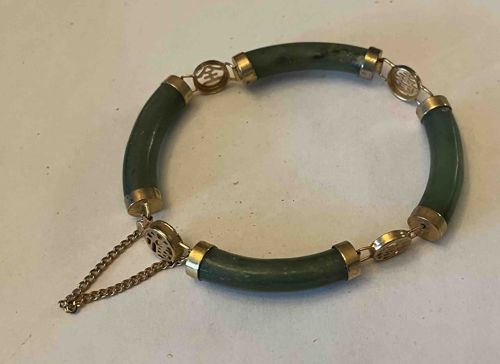
This item is a link bracelet featuring five curved, tubular sections of what appears to be dark green jade, possibly natural jadeite or nephrite, or a high-quality jade simulacrum. The jade segments are polished to a smooth, reflective finish. There are visible variations in the stone's color and translucency, with some areas appearing darker and more opaque, suggesting natural material. Each jade segment is capped at both ends with gold-toned metal ferrules, which connect to round, flat gold-toned metal links. These links feature an openwork design, possibly depicting a Chinese character or a stylized longevity symbol, which is a common motif in Asian-inspired jewelry. The metal appears to be a yellow gold or gold-plated base metal, exhibiting a warm, slightly aged patina consistent with its style period. The bracelet is secured by a clasp mechanism (partially visible) and includes a safety chain, a common feature for added security in bracelets of this type. The overall construction suggests a combination of natural materials and metalwork. While condition appears good, potential wear might be present on the metal surfaces or slight abrasions on the jade, which are not clearly discernible from the image. The design points towards an East Asian aesthetic, likely from the mid to late 20th century. The craftsmanship appears to be of decent quality, combining traditional material with functional jewelry design.
AI Appraisal Report
Upon visual inspection of the provided image, I assess this Jade and Gold-Toned Link Bracelet. The five curved, tubular sections exhibit characteristics suggestive of natural jade, possibly jadeite or nephrite, given the visible color variations and translucency. However, without in-person examination, spectroscopic analysis, or gemological testing, I cannot definitively confirm the natural origin or specific type of jade, nor rule out high-quality simulants. The gold-toned metal ferrules and openwork links appear to be either yellow gold or gold-plated base metal, showing a warm, aged patina. The openwork design, likely a Chinese character or longevity symbol, is consistent with an East Asian aesthetic, placing its probable origin in the mid to late 20th century.
The overall condition appears good from the image, but I cannot assess minute surface scratches on the metal or the jade, or the integrity of the clasp mechanism. Authenticity of the jade is the primary variable affecting value; if proven natural jadeite, the value increases significantly. Market demand for jade jewelry, particularly pieces with cultural motifs, remains steady but depends heavily on material authenticity and quality. Comparables for pieces with confirmed natural jadeite and solid gold components would be substantially higher. However, for a gold-toned, possibly plated item with unverified jade, the market is more aligned with costume or vintage fashion jewelry.
Factors significantly impacting value include the actual material composition of the jade (natural vs. simulant, jadeite vs. nephrite) and the metal (solid gold vs. plated base metal). Without physical inspection to verify these, and to accurately assess the clasp functionality and overall wear, this appraisal is limited. Full authentication would require direct examination by a certified gemologist, specific gravity tests, refractivity readings, and potentially Raman spectroscopy for the jade, and metal purity testing for the gold-toned components. Provenance documentation, if available, would also aid in value determination.