These notes were written by the person who submitted this item. Appraiser.AI has not verified them, and the AI's identification and estimate may rely on them.
AI Estimated Value
Not an official valuation
$150-250
AI estimate as of October 22, 2025 · verify with a professional before acting
AI-Generated · Verify before acting
Everything on this page is generated by AI for informational purposes only. AI can make mistakes — the AI may misidentify items or misattribute them (artist, maker, brand, designer, origin, era). This is not an official valuation and should not be used for insurance, sale, tax, estate, legal, or lending purposes — or any decision requiring a certified appraisal. It is not an authoritative claim about any person, brand, or rights holder — do not share or rely on it as a factual statement about a third party. Always consult qualified professionals before making financial decisions.
This analysis also relies on unverified notes provided by the user, which may be incomplete or inaccurate and could affect the result.
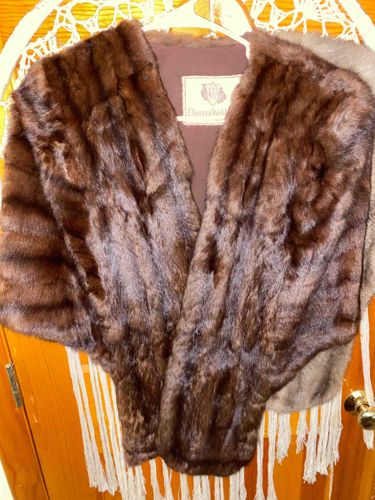
This appears to be a vintage fur stole or capelet, characterized by its rich, dark brown coloration with natural variations in hue, highlighting lighter brown undertones and darker guard hairs, suggesting a natural fur type like mink or sable, though specific identification without closer inspection is difficult. The fur presents as soft and lustrous, with visible pelts stitched together in horizontal or diagonal strips to form the garment's shape. The overall construction suggests a classic, elegant design meant to drape over the shoulders, likely as an evening accessory. The interior is lined with a smooth, dark brown fabric, possibly satin or silk, which provides a comfortable finish against the skin and protects the fur's leather backing. A distinctive label from 'Cherry & Webb' is prominently stitched onto the lining, indicating the retailer or manufacturer. Cherry & Webb was a well-known department store chain, suggesting an estimated age from the mid-20th century, likely between the 1940s and 1970s, during which fur garments were highly fashionable. Visible condition issues are minor based on the image; the fur appears generally well-preserved with good pile depth, though careful examination for shedding, dry rot, or matting would be necessary for a full appraisal. The quality of craftsmanship is indicated by the careful seaming of the pelts and the finished lining. The item is currently displayed on a white plastic hanger, indicative of home storage. The fringes of a lace or crocheted item are visible behind the stole, which is an unrelated background element.
AI Appraisal Report
I have examined the provided image of this vintage dark brown fur stole/capelet, noting its rich coloration and classic design. The visible pelts, stitched in strips, suggest a natural fur, likely mink or sable, although definitive species identification requires in-person inspection. The fur appears soft and lustrous with good pile depth, indicating generally well-preserved condition from the visual evidence. The presence of the 'Cherry & Webb' label is a valuable detail, dating the piece to the mid-20th century (1940s-1970s), a period when such garments were highly fashionable. The construction, with its smooth lining, speaks to careful craftsmanship.
Market conditions for vintage fur, particularly stoles and capelets, have softened considerably in recent decades due to changing fashion trends and ethical considerations. While items from prestigious furriers or made from rarer furs can command higher prices, general vintage fur stoles typically fetch modest amounts unless they are exceptionally rare, pristine, or associated with a significant provenance. Comparing this piece to similar vintage fur stoles from department stores, I find that demand is moderate, driven primarily by collectors of vintage apparel or individuals seeking unique accessories.
Factors impacting value include the general good condition observed, the recognizable retailer label, and the classic style. However, the exact fur type, and any hidden condition issues such as dry rot, extensive shedding, matting, or significant lining damage, cannot be assessed from images alone. A physical inspection would be crucial to verify the integrity of the pelts, assess flexibility of the leather backing, confirm the fur species, and rule out undetectable odors. Without in-person examination, provenance documentation, or scientific testing, absolute authenticity and specific fur type cannot be guaranteed. Based on current market trends for similar vintage fur items in good visual condition, I estimate its value to be in the range of $150-250.