AI estimate as of November 2, 2025 · verify with a professional before acting
AI-Generated · Verify before acting
Everything on this page is generated by AI for informational purposes only. AI can make mistakes — the AI may misidentify items or misattribute them (artist, maker, brand, designer, origin, era). This is not an official valuation and should not be used for insurance, sale, tax, estate, legal, or lending purposes — or any decision requiring a certified appraisal. It is not an authoritative claim about any person, brand, or rights holder — do not share or rely on it as a factual statement about a third party. Always consult qualified professionals before making financial decisions.
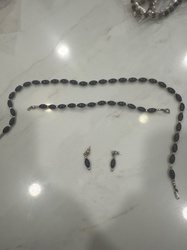
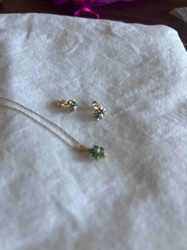
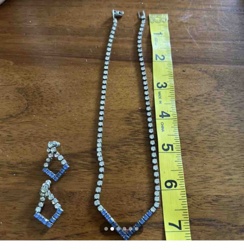
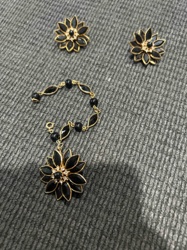
This is a matching parure, or jewelry set, consisting of a necklace, a bracelet, and a pair of clip-on earrings. The items are crafted from a silver-toned metal, likely rhodium-plated base metal, and adorned with numerous black and clear rhinestones. The design features alternating rows of clear, round-cut rhinestones and black, marquise-shaped rhinestones, creating a striking contrast. Each piece exhibits a similar pattern: a central row of black marquise stones flanked on either side by rows of smaller, clear round stones. The craftsmanship appears to be a pave or channel setting for the smaller stones and bezel settings for the larger marquise stones, securely holding them in place. The backings of the pieces, particularly visible on the bracelet, show a hinged or articulated construction, suggesting flexibility and comfort when worn. The earrings are clip-on style, indicating a potential age from the mid-20th century to later, as pierced earrings became more common. There are no immediate visible signs of missing stones, significant tarnishing, or heavy wear. The rhinestones retain their sparkle, suggesting good condition. The uniformity in design and materials across all three pieces indicates they were manufactured as a single set. This type of costume jewelry generally dates from the mid-20th century, likely 1940s-1970s, reflecting the glamorous styles of the era. No maker's marks or signatures are discernible from the provided images.
AI Appraisal Report
Based on my visual examination of the provided image, this Black and Clear Rhinestone Parure, comprising a necklace, bracelet, and clip-on earrings, appears to be in very good condition. The uniformity of the silver-toned metal (likely rhodium-plated base metal) and the consistent design featuring alternating clear round and black marquise-shaped rhinestones strongly indicate an authentic matched set. All stones appear present, with no visible tarnishing or significant wear, and they retain their sparkle, which is crucial for rhinestone jewelry. The clip-on earring style and overall aesthetic suggest a mid-20th century origin, likely 1940s-1970s, typical of glamorous costume jewelry from that era. The articulated construction noted on the bracelet further supports quality manufacturing for a comfortable fit.
In terms of market conditions, vintage rhinestone parures are in moderate demand, particularly those in excellent condition and with a cohesive design like this one. Comparable sets, especially unsigned pieces, typically sell in the lower to mid-hundreds. The absence of a discernible maker's mark limits its value compared to signed pieces by prominent costume jewelry designers (e.g., Eisenberg, Sherman, Weiss). Rarity is not exceptionally high for unsigned rhinestone sets; however, the set's complete and well-preserved nature enhances its desirability.
Factors significantly impacting value here are the excellent condition, the completeness of the parure, and the classic, versatile design. The primary limitation in authenticity verification from images alone is the inability to physically inspect the weight, material composition (e.g., lead content in metal, glass vs. plastic rhinestones), and precise construction methods. For full authentication and a definitive material assessment, an in-person examination, potentially including non-destructive material testing, would be required. Without physical inspection, I cannot confirm the exact metal composition or the quality of the rhinestone faceting beyond what is visible.