AI estimate as of July 16, 2025 · verify with a professional before acting
AI-Generated · Verify before acting
Everything on this page is generated by AI for informational purposes only. AI can make mistakes — the AI may misidentify items or misattribute them (artist, maker, brand, designer, origin, era). This is not an official valuation and should not be used for insurance, sale, tax, estate, legal, or lending purposes — or any decision requiring a certified appraisal. It is not an authoritative claim about any person, brand, or rights holder — do not share or rely on it as a factual statement about a third party. Always consult qualified professionals before making financial decisions.
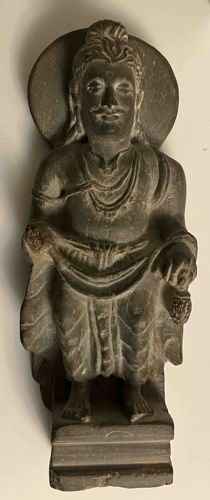
This is a standing male figure, likely a Bodhisattva, carved from a dark, possibly schist or slate, stone. The color appears to be a muted greyish-green or dark grey, suggesting age and potential natural patination. The figure stands frontally, with arms bent at the elbow, holding what appear to be offerings or attributes in each hand: a cluster of grapes or similar fruit in the left hand (viewer's right) and an indistinct object, possibly a garland or drape, in the right hand (viewer's left). The figure is adorned with jewelry, including a necklace and armbands. The drapery of the clothing is visible, particularly the folds of the lower garment (dhoti) and a sash across the torso. There is a distinct halo or nimbus behind the head, indicating divinity or enlightenment. The facial features are quite detailed, exhibiting an oval face, pronounced eyes with heavy lids, a straight nose, and a delicately rendered mustache, characteristic of Gandharan art. The hair is intricately styled into a topknot (ushnisha). The sculpture rests on a stepped rectangular base, which seems to be integral to the piece. The overall condition shows considerable wear consistent with age, including surface abrasions and some loss of definition in finer details, particularly on the hands and drapery. There are no obvious breaks or repairs, but the edges of the base show some chipping. The quality of craftsmanship is good, demonstrating skilled carving techniques typical of classical Gandharan workshops, emphasizing realistic human portrayal combined with spiritual iconography.
AI Appraisal Report
I have carefully examined the provided image of this Gandharan Bodhisattva sculpture. Based on my visual assessment, the condition shows significant wear consistent with age, including surface abrasions and some loss of definition in finer details, particularly on the hands and drapery. The edges of the integral stepped base exhibit chipping. No obvious breaks or repairs are immediately apparent, which is positive. The style, iconography (halo, topknot, mustache, drapery), and apparent material (dark schist or slate with patination) are highly consistent with authentic Gandharan Buddhist art from the 1st-4th centuries CE. The detailed facial features and realistic portrayal suggest skilled craftsmanship from a reputable workshop.
Market conditions for authentic Gandharan sculptures remain robust, especially for well-preserved examples. Comparables in similar condition have achieved prices ranging from mid-to-high five figures at international auction houses. This piece, while showing wear, retains strong artistic merit. Demand is global, driven by both private collectors and institutions. The rarity lies in finding authentic, intact Gandharan pieces of this size and quality. Factors positively impacting value include its identifiable Bodhisattva form, the detailed carving, and the presumed original base. The primary limiting factor is the extent of surface wear impacting the crispness of details.
It is crucial to state that my authenticity verification is limited to visual examination of the image. For full authentication, an in-person examination is paramount to assess the stone's properties, carving techniques, and patination microscopically. Provenance documentation, detailing the sculpture's history of ownership, is absolutely essential. Finally, scientific testing, such as elemental analysis of the stone or thermoluminescence dating if appropriate for the material, would confirm its age and material composition, solidifying its authenticity and significantly impacting its market value.