AI estimate as of September 30, 2025 · verify with a professional before acting
AI-Generated · Verify before acting
Everything on this page is generated by AI for informational purposes only. AI can make mistakes — the AI may misidentify items or misattribute them (artist, maker, brand, designer, origin, era). This is not an official valuation and should not be used for insurance, sale, tax, estate, legal, or lending purposes — or any decision requiring a certified appraisal. It is not an authoritative claim about any person, brand, or rights holder — do not share or rely on it as a factual statement about a third party. Always consult qualified professionals before making financial decisions.
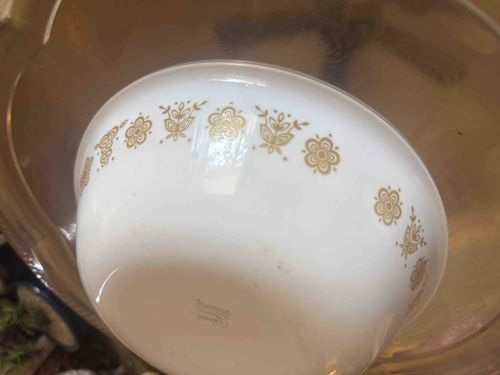
This item is a vintage Corning Ware casserole dish, specifically from the 'Spice of Life' pattern, indicated by the distinctive floral and botanical motifs rendered in a warm, muted gold color. The dish is made of white opaque pyroceram, a ceramic-glass material known for its thermal shock resistance and durability. The design features a continuous band of alternating floral elements, including stylized flowers and sprigs with leaves, encircling the upper exterior perimeter of the bowl. The gold decoration appears to be in good condition with minimal wear or fading, suggesting careful use or preservation. The bowl has a smooth, glossy finish typical of Corning Ware products. Visible on the bottom of the bowl is a faint, partially obscured manufacturer's mark, which appears to read "Corning Ware" and further alphanumeric codes such as "P-1 3/4-B" and indications of its oven-to-table functionality. The 'Spice of Life' pattern was highly popular from the late 1960s through the 1980s, placing its estimated age within this period. There are no immediately apparent chips, cracks, or significant damage, though some minor staining or discoloration might be present on the white surface, consistent with age and use. The craftsmanship is utilitarian yet aesthetically pleasing, showcasing the iconic mid-century modern kitchenware design. The specific size, 'P-1 3/4-B', suggests a capacity of 1 and 3/4 quarts, making it a versatile piece for baking, serving, and storage.
AI Appraisal Report
Based on my visual examination of the provided image, this Corning Ware 'Spice of Life' Pattern Casserole Dish (P-1 3/4-B) appears to be in very good vintage condition. The 'Spice of Life' pattern, with its distinctive gold floral and botanical motifs, is clearly visible and shows minimal wear, fading, or scratching, indicating careful use or preservation. The white pyroceram body exhibits a smooth, glossy finish, and there are no immediate signs of chips, cracks, or significant damage. The partially obscured manufacturer's mark 'Corning Ware P-1 3/4-B' on the bottom supports its authenticity as a genuine Corning Ware product from the highly popular 'Spice of Life' line, dating its likely production between the late 1960s and 1980s. This size (1.75 quarts) is a common and versatile piece.
Market conditions for vintage Corning Ware, particularly the 'Spice of Life' pattern, are generally stable with consistent demand among collectors and those seeking nostalgic kitchenware. However, individual pieces, especially common sizes without lids, tend to be readily available. The item's value is bolstered by its apparent excellent condition and the enduring popularity of the pattern. Factors that could enhance value would include the presence of its original Pyrex lid (if applicable), which is not visible here, and exceptionally pristine condition. Conversely, any unseen staining, odors, chips, or significant utensil marks would decrease value.
While the visual evidence strongly suggests authenticity and excellent condition, a full in-person examination would be required to definitively confirm the complete absence of hairline cracks, interior staining, or any surface imperfections not visible in the image. Physical inspection would also allow for precise assessment of the integrity of the base stamp and overall surface quality. Provenance documentation, though rarely available for such items, would further solidify authentication but is not typically expected for this category of kitchenware. Scientific testing is not necessary for authenticating this type of item.