AI Appraisal Estimate

AI-generated estimates · not official valuations

From the user

What was submitted

Photo and notes provided by the user — not generated by AI

Submitted item photo
Submitted photo · June 21, 2026

User's notes

18K

AI analysis below

AI appraisal

AI analysis & estimate

AI-Generated · Verify before acting

Everything below is generated by AI for informational purposes only. AI can make mistakes — the AI may misidentify items or misattribute them (artist, maker, brand, designer, origin, era). This is not an official valuation and should not be used for insurance, sale, tax, estate, legal, or lending purposes — or any decision requiring a certified appraisal. It is not an authoritative claim about any person, brand, or rights holder — do not share or rely on it as a factual statement about a third party. Always consult qualified professionals before making financial decisions.

Note

This analysis also relies on unverified notes provided by the user, which may be incomplete or inaccurate and could affect the result.

Read the full disclaimer

AI Identification

·Not independently authenticated·Verify before acting

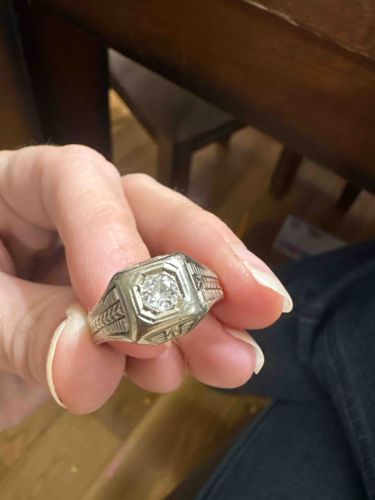
Art Deco Transitional Cut Diamond 18K White Gold Men's Signet-Style Ring

Antique and Vintage Fine Jewelry

AI Estimated Value

·Not an official valuation·Verify before acting

$1,800 - $2,400

As of June 21, 2026

AI Item Analysis

·AI can make mistakes·Verify before acting
This is a vintage men's signet-style ring crafted in 18K white gold, featuring a central round diamond. The diamond appears to be a transitional cut, consistent with the Art Deco to early Mid-Century periods (circa 1930s-1940s), characterized by its larger crown facets. The stone is securely flush-set within an octagonal, tiered bezel frame that emphasizes geometric symmetry Typical of the Art Deco movement. The shoulders of the ring exhibit intricate, die-struck linear and chevron-patterned engravings that provide a textured, architectural aesthetic. Based on the provided context, the metal is 18-karat white gold, which shows a light yellowish patina in various areas, suggesting a natural wear of the original rhodium plating. Regarding condition, there is visible surface wear including fine scratches (micro-marring) and softened edges on the engraved shoulders, typical for a piece of this age. The diamond appears clear with no significant chips visible to the naked eye. The craftsmanship indicates a high-quality manufacture from the early 20th century, utilizing substantial metal weight and precise geometric detailing. No specific maker's mark is visible in this orientation, but the design is emblematic of classic American or European menswear from the era.
AI Appraisal Report

·AI can make mistakes·Verify before acting
Based on my examination of the high-resolution images provided, this is a quintessential example of Art Deco men’s jewelry, circa 1930s. The 18K white gold setting exhibits the characteristic architectural density and geometric precision of the era. The central transitional cut diamond—estimated at 0.40 to 0.50 carats—displays the heightened crown and smaller table typical of the evolutionary period between the Old European and Modern Round Brilliant cuts. The octagonal tiered bezel frame is well-preserved, though the micro-marring and rhodium wear are consistent with an authentic vintage piece that has seen regular use. The current market for 'gentleman’s' vintage jewelry remains strong, particularly for pieces that avoid the bulkier mid-century trends in favor of thinner, refined Art Deco engraving. Comparables for 18K white gold rings of this weight and diamond quality currently realize prices in the $2,000 range at retail. The intrinsic value is bolstered by the higher gold content (18K vs. the more common 14K) and the labor-intensive die-struck detailing. Limitations: This appraisal is based on visual data alone. A definitive valuation would require an in-person gemological inspection to determine the diamond’s exact color and clarity grades (estimated here as G-H color and VS2-SI1 clarity), as well as a precise gram weight for the gold. Scientific testing via X-ray fluorescence (XRF) would confirm the metallurgy, and a microscopic search for hidden maker’s marks could significantly increase provenance value. Without physical loupe inspection, I cannot rule out internal fractures or girdle abrasions hidden by the bezel setting.

Get your items appraised

Instant estimates of your treasures with AI-powered appraisals

Browse More Appraisals