AI estimate as of October 8, 2025 · verify with a professional before acting
AI-Generated · Verify before acting
Everything on this page is generated by AI for informational purposes only. AI can make mistakes — the AI may misidentify items or misattribute them (artist, maker, brand, designer, origin, era). This is not an official valuation and should not be used for insurance, sale, tax, estate, legal, or lending purposes — or any decision requiring a certified appraisal. It is not an authoritative claim about any person, brand, or rights holder — do not share or rely on it as a factual statement about a third party. Always consult qualified professionals before making financial decisions.
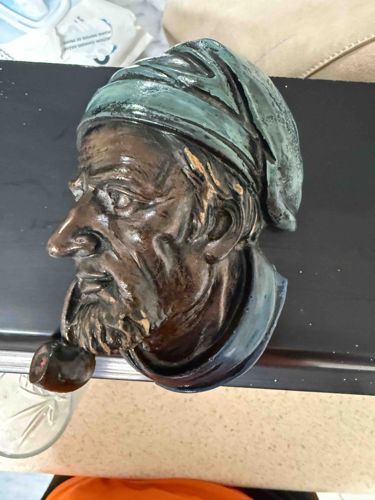
This item is a dimensional relief plaque depicting the profile of an older, bearded man smoking a pipe. The sculpture appears to be made from a cast material, possibly resin or a cold-cast bronze composite, given its metallic sheen and the typical appearance of such items. The color palette is primarily dark bronze for the facial features, contrasted with a verdigris patina effect on the man's cap and the collar of his garment. The texture of the face suggests aged skin, with visible wrinkles around the eye and across the brow, indicating careful detailing in the mold. The beard is robust and textured, flowing down to connect with the pipe stem. The pipe itself is dark and protruding from the man's mouth. The cap has a distinct folded or bunched appearance, rendered in a teal or oxidized copper green color, suggesting weathered metal. The craftsmanship indicates a moderate level of detail and artistic expression, capturing a characterful countenance. There are no visible maker's marks or signatures in the provided images. The condition appears good, with the patina intentionally applied to enhance its aged aesthetic. The overall style suggests a vintage European folk art or tavern theme, likely dating from the mid-20th century or later. The dark background visible behind the plaque suggests it may be mounted on a wooden base or designed to be hung on a wall. The absence of significant chipping or cracking indicates reasonable care or resilient material construction. This piece exhibits qualities typical of decorative wall art designed to evoke an old-world charm.
AI Appraisal Report
Based on my visual examination of the provided image, this relief plaque, depicting a bearded man with a pipe in profile, appears to be in good overall condition. The metallic sheen and the typical appearance strongly suggest it is crafted from a cast material, likely resin or a cold-cast bronze composite, rather than solid bronze. The intentional verdigris patina on the cap and collar enhances its aged aesthetic, and I observe no significant damage such as chips, cracks, or repairs. Authenticity, in terms of being a unique art piece versus a mass-produced decorative item, is limited without physical inspection. The absence of maker's marks or signatures common on fine art pieces points towards it being a decorative wall art item.
Market conditions for such decorative wall art pieces, particularly those evoking vintage European folk art or tavern themes, are generally stable but not highly lucrative. Comparable items frequently appear in secondary markets, such as online marketplaces and antique malls, often priced within the two-digit to low three-digit range. The demand for these items is primarily from individuals seeking specific decorative accents for themed interiors, rather than collectors of fine art or historical artifacts. Rarity is not a significant factor here; while this specific design may not be ubiquitous, the production method allows for numerous reproductions, limiting its potential for significant appreciation.
Factors significantly impacting value include the material (composite rather than solid metal), the probable production method (cast reproduction), and the lack of an identifiable artist or provenance. While the craftsmanship is detailed and characterful, these elements position it as an attractive decorative accessory rather than a high-value collectible. For a more definitive authentication regarding material composition or the presence of hidden marks, an in-person examination, potentially including non-destructive testing for material analysis, would be essential. Provenance documentation, if available, could offer insights into its specific origin and age, though for items of this type, such documentation is rare.