These notes were written by the person who submitted this item. Appraiser.AI has not verified them, and the AI's identification and estimate may rely on them.
AI Estimated Value
Not an official valuation
$350-650
AI estimate as of June 28, 2025 · verify with a professional before acting
AI-Generated · Verify before acting
Everything on this page is generated by AI for informational purposes only. AI can make mistakes — the AI may misidentify items or misattribute them (artist, maker, brand, designer, origin, era). This is not an official valuation and should not be used for insurance, sale, tax, estate, legal, or lending purposes — or any decision requiring a certified appraisal. It is not an authoritative claim about any person, brand, or rights holder — do not share or rely on it as a factual statement about a third party. Always consult qualified professionals before making financial decisions.
This analysis also relies on unverified notes provided by the user, which may be incomplete or inaccurate and could affect the result.
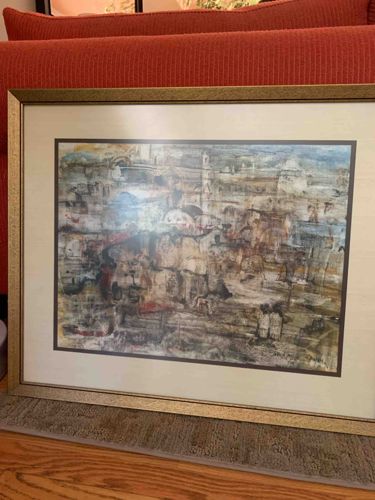
This rectangular framed artwork presents an evocative abstract or semi-abstract interpretation of a city, strongly suggesting the dense architectural character of Jerusalem, as indicated by the provided context. The piece utilizes a rich, muted color palette dominated by browns, greys, and blacks, with strategic applications of dull blues, subtle reds, and hints of green that add depth and visual interest. The technique appears to involve layering and visible textures, possibly achieved through mixed media, impasto, or distinctive brushwork in paint (e.g., acrylics, gouache, or watercolor) on paper or board. Shapes within the composition vaguely resemble buildings, walls, and urban structures, evoking a sense of historical density and timelessness. A discernible signature is located in the lower right corner of the artwork, although it is illegible in the provided image. The artwork is professionally matted with a wide, off-white or cream-colored mat board, providing a clean border. It is encased under glass, which exhibits significant reflections and glare in the photograph, obscuring some details of the art itself. The frame is a substantial gold-finished piece, possibly wood or composite material, featuring a subtly textured or aged appearance, consistent with modern or contemporary framing styles. Overall condition appears good for both frame and mat, though the glare prevents full assessment of the artwork's surface. The piece reflects the 'modern Israeli artist scene' context, suggesting its creation by an artist working within this period and cultural milieu. Its craftsmanship points to a curated piece designed for display.
AI Appraisal Report
Based on my examination of the provided images and information, this framed abstract cityscape, suggestive of Jerusalem, appears to be a well-presented piece from the modern Israeli art scene. The professional matting and substantial gold-finished frame are in good apparent condition, contributing positively to its display value. The artwork itself uses a compelling muted palette with engaging textures, suggesting a skillful hand.
However, the single most critical factor impacting a definitive appraisal is the illegible signature. Without a clear identification of the artist, authenticating the piece is impossible based solely on visuals. This significantly shifts its market placement from a potentially recognized artist to a decorative art category, where value is primarily driven by aesthetic appeal rather than artist provenance or collectibility.
Market conditions for unaccredited modern abstract works vary widely, but typically, they sell at much lower price points than works by listed artists. Comparables would be similar-sized, framed contemporary abstracts by unknown or emerging artists, often found in smaller galleries or online platforms. Demand for such pieces is generally driven by personal taste rather than investment potential.
To fully authenticate and provide a more precise valuation, an in-person examination is crucial. This would allow for a thorough inspection of the artwork's surface condition (checking for pigment loss, discoloration, or moisture damage, currently obscured by glare), a detailed analysis of the medium, and most importantly, a close inspection of the signature to attempt identification. Provenance documentation, such as original purchase receipts or exhibition history, would also be vital in verifying authorship and establishing historical context.