AI estimate as of July 27, 2025 · verify with a professional before acting
AI-Generated · Verify before acting
Everything on this page is generated by AI for informational purposes only. AI can make mistakes — the AI may misidentify items or misattribute them (artist, maker, brand, designer, origin, era). This is not an official valuation and should not be used for insurance, sale, tax, estate, legal, or lending purposes — or any decision requiring a certified appraisal. It is not an authoritative claim about any person, brand, or rights holder — do not share or rely on it as a factual statement about a third party. Always consult qualified professionals before making financial decisions.
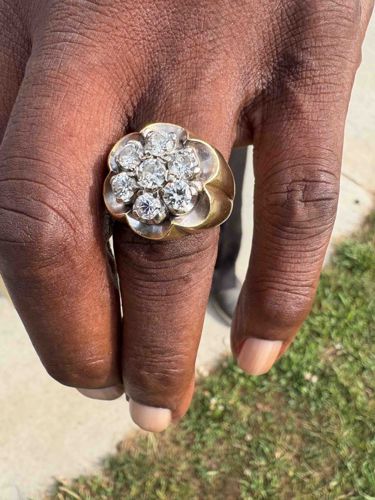
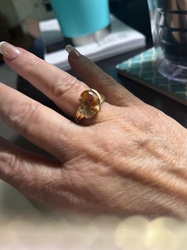
The item is a prominent cocktail or statement ring, featuring a cluster design reminiscent of a floral motif. The ring's head appears to be crafted from at least two different metals: a yellow or gold-toned metal forms the base and possibly the shank, while a lighter, likely white metal (such as white gold, platinum, or silver) is used for the settings around the central cluster of stones. The design consists of a central large clear stone surrounded by eight smaller clear stones, creating a nine-stone cluster. Each stone appears to be a brilliant cut, exhibiting significant sparkle and fire, suggesting they are either diamonds or high-quality diamond simulants. The setting for the stones is likely a prong setting, securing each individual gem within the white metal. The overall shape of the cluster is rounded, forming a substantial dome on the finger. The shank of the ring appears to be thick and solid, tapering slightly towards the palm side of the hand. The general aesthetic of the ring suggests a vintage or antique origin, possibly from the mid-20th century, given its robust construction and popular cluster design of that era. There are no visible chips or significant abrasions on the stones from the image. The metal parts of the ring show signs of light wear consistent with age, including very minor surface scratches and a subtle tarnishing or patina on the gold-toned metal, particularly in recessed areas. The craftsmanship appears to be of good quality, with secure settings and a well-proportioned design, indicative of a piece intended for significant display and wear.
AI Appraisal Report
Based on my visual examination of the provided image, this Cluster Diamond Cocktail Ring presents as a robust and eye-catching piece, likely dating from the mid-20th century. The two-tone metal construction, featuring a yellow-toned base with white metal settings for the stones, is consistent with vintage designs. The nine-stone cluster, with a central larger stone surrounded by eight smaller ones, forms an attractive floral-like motif. The stones exhibit significant sparkle, suggesting they are either diamonds or high-quality diamond simulants. However, without in-person examination, I cannot definitively confirm the authenticity of the stones as natural diamonds; they could be moissanite, cubic zirconia, or synthetic diamonds. Similarly, the metals appear to be gold and a white gold/platinum alloy, but hallmarks or scientific testing would be required for confirmation.
Condition-wise, the ring shows expected light wear for its apparent age, including minor surface scratches on the metal and a slight patina in recessed areas. There are no visible chips or significant abrasions on the stones. Craftsmanship appears good, with secure prong settings.
The market for vintage cocktail rings remains steady, with demand for pieces featuring genuine diamonds being consistently strong. If the stones are indeed diamonds and the metals are gold/platinum, the value would be significantly higher. Comparables for genuine diamond cluster rings of this size can range from several hundred to a few thousand dollars depending on carats, clarity, and color.
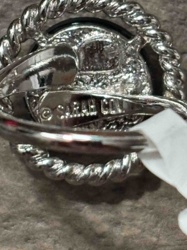
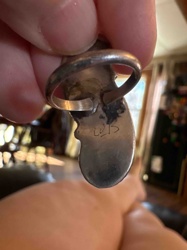
Limitations: A full authentication would require physical inspection to test the metal purity (e.g., acid or XRF testing), confirm the nature of the stones (e.g., diamond tester, refractometer, specific gravity, microscopic examination for inclusions), and identify any hallmarks. Provenance documentation, if available, would also aid in confirming its history and authenticity. This appraisal is based solely on visual characteristics from the image.