These notes were written by the person who submitted this item. Appraiser.AI has not verified them, and the AI's identification and estimate may rely on them.
AI Estimated Value
Not an official valuation
$50 - $100
AI estimate as of August 1, 2025 · verify with a professional before acting
AI-Generated · Verify before acting
Everything on this page is generated by AI for informational purposes only. AI can make mistakes — the AI may misidentify items or misattribute them (artist, maker, brand, designer, origin, era). This is not an official valuation and should not be used for insurance, sale, tax, estate, legal, or lending purposes — or any decision requiring a certified appraisal. It is not an authoritative claim about any person, brand, or rights holder — do not share or rely on it as a factual statement about a third party. Always consult qualified professionals before making financial decisions.
This analysis also relies on unverified notes provided by the user, which may be incomplete or inaccurate and could affect the result.
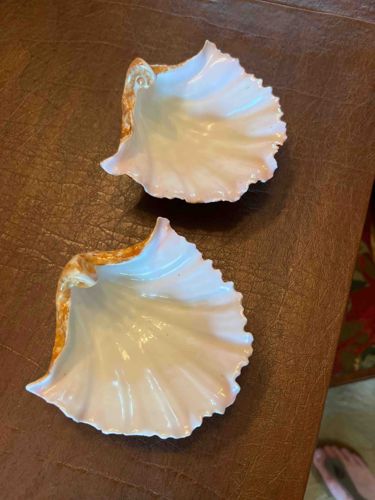
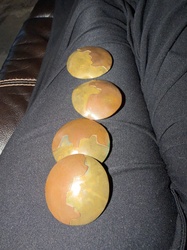
This lot consists of two matching decorative dishes, each appearing to be a natural scallop shell that has been treated and possibly hand-painted or lacquered. The interior surface of each shell exhibits a luminous, pearlescent white coloration with subtle hints of opalescent pinks and blues, particularly visible in the play of light across its undulating surface. The exterior or reverse side of the shells, as hinted by the visible edges, shows a natural orange-brown hue, characteristic of many scallop shell species, creating a pleasing contrast with the polished interior. The edges of the shells are naturally scalloped and slightly irregular, demonstrating their organic origin. While no specific maker's marks or signatures are discernible from the provided images, the smooth, glossy finish on the interior suggests a careful finishing process, possibly involving a clear protective coating or lacquer to enhance durability and aesthetic appeal. Given the 'hand painted shell dishes' context, it's likely these finishes were applied intentionally for decorative purposes. The craftsmanship appears to be of good quality, focusing on preserving the natural beauty of the shells while making them suitable for display or as small receptacles. There are no obvious signs of significant wear, damage, or repairs, and the pieces appear to be in good, well-preserved condition, suggesting an estimated age from mid-20th century to contemporary.
AI Appraisal Report
Upon examining the images of this pair of natural scallop shell dishes with a pearlescent finish, I find them to be in good, well-preserved condition. The interior's luminous pearlescent white, with subtle opalescent pinks and blues, indicates a careful finishing process, likely hand-painted or lacquered as suggested. The contrast with the natural orange-brown exterior is aesthetically pleasing. Given the smooth, glossy finish and lack of visible wear, damage, or repairs, the craftsmanship appears to be of good quality, preserving the shells' natural beauty while enhancing them for decorative use. The "hand painted shell dishes" context is consistent with their appearance.
From images alone, definitive authentication of the precise finishing process (e.g., hand-painting vs. industrial lacquering) or specific age (mid-20th century vs. contemporary) is limited. An in-person examination would allow for tactile inspection of the finish, assessment of microscopic paint application, and closer examination for any maker's marks or aging indicators not visible here. Provenance documentation, such as original purchase receipts or artist information, would be crucial for establishing a definitive age or the artisan's identity, which could significantly impact value for collectible pieces.
Market conditions for decorative shell items are generally stable, with demand for unique or artistically enhanced natural objects. While not inherently rare as natural shells are common, the quality of the pearlescent finish, if indeed hand-applied with artistry, elevates them beyond mass-produced items. Comparables would include other decorative natural shell items, often fetching modest prices unless associated with a well-known artist or historical significance. Factors impacting value here would primarily be the aesthetic appeal, condition, and the perceived quality of the decorative treatment. Without proven artist attribution or significant historical provenance, their value remains primarily decorative.