AI estimate as of July 20, 2025 · verify with a professional before acting
AI-Generated · Verify before acting
Everything on this page is generated by AI for informational purposes only. AI can make mistakes — the AI may misidentify items or misattribute them (artist, maker, brand, designer, origin, era). This is not an official valuation and should not be used for insurance, sale, tax, estate, legal, or lending purposes — or any decision requiring a certified appraisal. It is not an authoritative claim about any person, brand, or rights holder — do not share or rely on it as a factual statement about a third party. Always consult qualified professionals before making financial decisions.
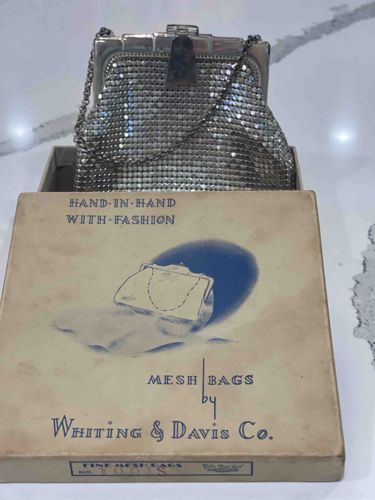
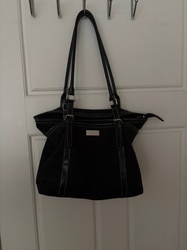
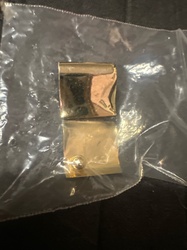
This is a vintage Whiting & Davis Co. mesh purse, likely dating from the early to mid-20th century, specifically the Art Deco or Retro era, given the company's prominence in mesh fashion during those periods. The purse features a highly reflective, fine metal mesh construction, which makes up the entire body of the bag. The purse has a structured metal frame at the top, which forms the opening and closing mechanism, secured by a prominent clasp. This clasp appears to be a lever-style closure, with a raised element that pivots to open and close the bag. A delicate chain handle is attached to the metal frame, designed for carrying the purse. The overall color is a uniform silver or chrome tone, indicating the use of a polished, probably nickel or silver-plated, metal. The mesh is composed of numerous small, interconnected metal rings, creating a flexible and shimmering surface. The condition appears to be very good, with no obvious signs of significant damage, extensive tarnishing, or missing mesh pieces. The reflective quality of the mesh suggests it has been well-preserved. There are no visible maker's marks on the purse itself in this image, but the accompanying box clearly identifies it as a product of 'Whiting & Davis Co.' and specifies 'MESH BAGS.' The box also states 'HAND-IN-HAND WITH FASHION' and 'FINE MESH BAGS' along with a number 'Y82AS'. This original packaging adds significant value and authenticity to the item, indicating it may be New Old Stock (NOS) or very lightly used. The craftsmanship appears to be of high quality, consistent with the reputation of Whiting & Davis for their durable and fashionable mesh products.
AI Appraisal Report
I have carefully examined the provided image of this Whiting & Davis Co. Metal Mesh Purse with its original box. Based on my visual assessment, the purse appears to be in very good, potentially excellent, vintage condition. The metal mesh shows good reflectivity, suggesting minimal tarnishing or wear, and there are no visible missing pieces. The structured frame, clasp, and chain handle also seem well-preserved. The presence of the original box, clearly marked 'Whiting & Davis Co.' and 'MESH BAGS,' significantly enhances the item's authenticity and value. The box's design and reference to 'HAND-IN-HAND WITH FASHION' aligns with Whitting & Davis's peak popularity from the Art Deco through the Retro periods. The 'Y82AS' number on the box is likely a style or production code. This original packaging strongly suggests the item is New Old Stock (NOS) or has been very lightly used, which is a major value driver.
From a market perspective, vintage Whiting & Davis mesh bags remain popular among collectors of vintage fashion and accessories, particularly those from the early to mid-20th century. Examples in excellent condition, especially with original packaging, are harder to find and command higher prices. Comparables for similar silver-tone mesh purses from this era tend to range, but the box elevates this specific piece. Demand is consistent for quality examples from reputable makers.
Factors significantly impacting value here are the outstanding apparent condition, the complete and well-preserved original packaging, and the esteemed manufacturer. The only limitation in authenticity verification from an image alone is the inability to physically inspect the metal composition for any signs of repair, the functionality of the clasp, or any subtle odors. For full authentication and a definitive condition report, an in-person examination would allow for tactile inspection of the mesh integrity, clasp mechanism, and frame, as well as a more precise assessment of any minute cosmetic flaws not visible in the image. Provenance documentation, if available, such as original sales receipts, could further solidify its history, though the box largely serves this purpose in this instance.