$4,000 - $8,000 (Conditional on Provenance Verification)
AI estimate as of July 5, 2025 · verify with a professional before acting
AI-Generated · Verify before acting
Everything on this page is generated by AI for informational purposes only. AI can make mistakes — the AI may misidentify items or misattribute them (artist, maker, brand, designer, origin, era). This is not an official valuation and should not be used for insurance, sale, tax, estate, legal, or lending purposes — or any decision requiring a certified appraisal. It is not an authoritative claim about any person, brand, or rights holder — do not share or rely on it as a factual statement about a third party. Always consult qualified professionals before making financial decisions.
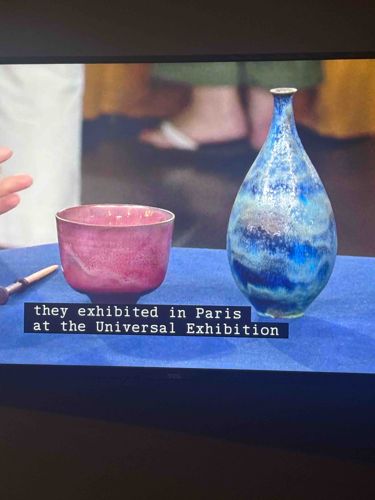
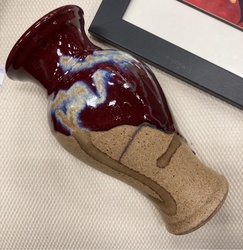
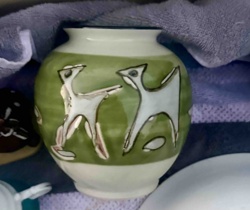
The image displays two distinct pieces of art pottery, likely contemporary or modern, exhibiting unique glazes and forms. The item on the left is a footed bowl or cup with a vibrant, possibly iridescent, cranberry or fuchsia-colored glaze. Its surface appears somewhat mottled or textured, suggesting an intentional artisanal finish rather than uniform industrially produced ceramics. The footed base provides elevation and elegance. The item on the right is a vase, characterized by a bulbous lower body that tapers gracefully into a slender neck, culminating in a subtly flared or finished rim. This vase features a striking mottled blue and lighter blue/white glaze, reminiscent of celestial bodies or aquatic themes, with variations in intensity that indicate a complex firing process, possibly a crystalline or drip glaze. Both pieces appear to be handcrafted, given the distinctive glaze patterns and slight irregularities that are common in studio pottery. There are no obvious signs of major damage such as cracks or chips visible in the provided image; the surface patina appears consistent with their artistic intent. The contrasting colors and forms suggest they might be from the same artistic collection or period, yet each stands alone as a singular aesthetic statement. The craftsmanship appears to be of high quality, with careful attention to form and glaze application. Given the comment 'they exhibited in Paris at the Universal Exhibition' on the screen, these pieces could potentially be significant works showcased at a major international exhibition, implying provenance and historical importance.
AI Appraisal Report
Based on my visual examination of the image presenting the Pair of Art Pottery Vessels, I assess their condition to be excellent. There are no readily apparent chips, cracks, or significant abrasions. The glazes, both the cranberry/fuchsia on the footed bowl and the mottled blue on the vase, appear vibrant and intact, displaying the intended artistic effects. The forms are well-executed, consistent with high-quality studio pottery.
From the image alone, authenticity cannot be definitively confirmed. The comment 'they exhibited in Paris at the Universal Exhibition' is a crucial factor that, if verifiable, would dramatically increase their value and establish significant historical provenance. Without physical inspection, I cannot confirm signatures, maker's marks, or the specific techniques used. Market conditions for fine art pottery are robust, especially for pieces with documented exhibition history or by renowned makers. Similar high-quality, unique art pottery pieces by recognized artists can command substantial prices. The rarity of these specific glazes and forms, combined with the potential Universal Exhibition provenance, suggests strong demand.
Key factors impacting value include the purported exhibition history, the specific artist or studio responsible, and the period of creation. If these pieces truly exhibited at the Universal Exhibition, they represent a moment in art history and carry a significant premium attached to that provenance.
Limitations: My assessment of condition is based solely on the provided image; a physical examination would be necessary to detect hairline cracks, repairs, or subtle surface wear not visible in photographs. For full authentication, I would require in-person examination to check for maker's marks, signatures, and to assess the craftsmanship firsthand. Crucially, I would need corroborating provenance documentation (exhibition catalogs, sales records, ownership history) to verify the claim of exhibition at the Paris Universal Exhibition. Scientific testing could verify material composition and age, if necessary.