AI estimate as of September 25, 2025 · verify with a professional before acting
AI-Generated · Verify before acting
Everything on this page is generated by AI for informational purposes only. AI can make mistakes — the AI may misidentify items or misattribute them (artist, maker, brand, designer, origin, era). This is not an official valuation and should not be used for insurance, sale, tax, estate, legal, or lending purposes — or any decision requiring a certified appraisal. It is not an authoritative claim about any person, brand, or rights holder — do not share or rely on it as a factual statement about a third party. Always consult qualified professionals before making financial decisions.
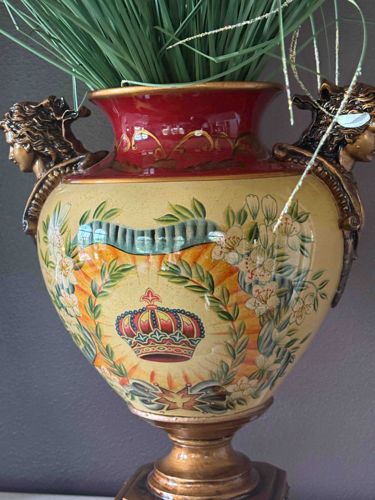
This is a decorative urn, likely ceramic or a composite material, styled in a Neoclassical or Baroque Revival manner. It features a bulbous body tapering towards a flared neck and a stepped pedestal base. The primary color scheme consists of a cream-yellow background on the main body, a rich dark red on the neck, and gilded accents throughout. The most striking features are the handles, which are sculpted in the form of female busts, possibly caryatids or goddesses, with elaborate hairstyles, executed in a metallic gold or bronze finish. The body of the urn is adorned with intricate hand-painted designs. A prominent central motif is a detailed red and gold crown surrounded by radiating light rays and encased within a laurel wreath. Flanking this motif are delicate floral arrangements with white blossoms and green foliage, as well as segments of architectural or landscape elements in soft blue-green tones, suggesting distant structures or water. The red neck is further embellished with gilt scrolling patterns. The base and the rim of the neck also have visible gold banding, displaying some wear or intentional antiquing that gives it a slightly distressed, aged appearance. The craftsmanship suggests a decorative piece, possibly mass-produced but with hand-finished elements, aiming for an opulent and historical aesthetic. There are no overt signs of significant damage like chips or cracks apparent from the image, but the gilded areas show some minor scuffing or loss of finish, consistent with age and handling. The overall condition appears good for a decorative item of this style, suitable for display. It likely dates from the late 20th century to early 21st century, imitating older styles.
AI Appraisal Report
Upon visual examination of the provided image, I assess this Neoclassical Style Hand-Painted Decorative Urn with Caryatid Handles. The condition appears good overall for a decorative item of its type, with no obvious major damage such as chips or cracks. However, I note typical wear to the gilded accents, including minor scuffing and some loss of finish, which is consistent with age and handling. This wear adds to a slightly distressed, aged aesthetic, which may be intentional or a natural consequence of time.
Authenticity, in terms of its purported age and style imitation, is a key consideration. Based on the craftsmanship and decorative elements, this urn appears to be a late 20th to early 21st-century reproduction or revival piece, rather than an authentic 18th or 19th-century antique. The painting style, while detailed, suggests mass production with hand-finished touches rather than bespoke artistry. The material, likely ceramic or a composite, further supports this assessment; older pieces would typically be porcelain or finely crafted pottery.
In terms of market conditions, items of this style, while aesthetically appealing, do not command premium prices unless they are genuine antique examples from renowned manufacturers or artists. Comparable items found in decorative arts auctions and online marketplaces, often described as 'Neoclassical style' or 'Baroque Revival,' typically fetch prices in the low to mid-hundreds. Demand for such decorative reproductions is moderate, appealing to those seeking an opulent aesthetic without the expense of true antiques. Rarity is not a significant factor here; similar decorative urns are relatively common.
Factors impacting value include the good condition (despite gilding wear) and the engaging design. Conversely, its likely status as a reproduction limits its top market value. Without physical inspection, it is impossible to definitively confirm the material composition, the exact quality of the hand-painting, or to rule out subtle repairs. For full authentication and to ascertain precise material composition, an in-person examination, potentially including non-destructive material analysis, would be required. Provenance documentation could also shed light on its manufacturing history, but this is often absent for decorative reproductions. Based on a visual appraisal, I estimate the value to be in the range of $150-250.