These notes were written by the person who submitted this item. Appraiser.AI has not verified them, and the AI's identification and estimate may rely on them.
AI Estimated Value
Not an official valuation
$80 - $150
AI estimate as of November 25, 2025 · verify with a professional before acting
AI-Generated · Verify before acting
Everything on this page is generated by AI for informational purposes only. AI can make mistakes — the AI may misidentify items or misattribute them (artist, maker, brand, designer, origin, era). This is not an official valuation and should not be used for insurance, sale, tax, estate, legal, or lending purposes — or any decision requiring a certified appraisal. It is not an authoritative claim about any person, brand, or rights holder — do not share or rely on it as a factual statement about a third party. Always consult qualified professionals before making financial decisions.
This analysis also relies on unverified notes provided by the user, which may be incomplete or inaccurate and could affect the result.
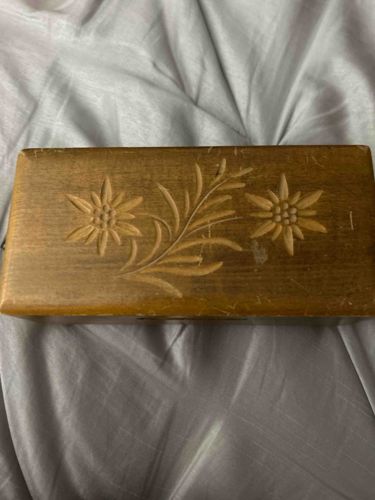
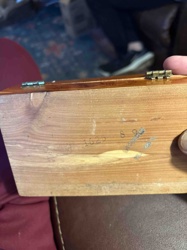
This is a vintage, rectangular wooden jewelry box, approximately 100 years old based on the provided context. The box is crafted from a light to medium-toned wood, possibly pine or birch, and features a warm, honey-brown patina that suggests age and regular handling. The top surface of the lid is adorned with intricate, hand-carved floral motifs, specifically two prominent Edelweiss flowers flanking a central, swirling vine design with leaves. The carving style is shallow relief, indicating traditional folk art craftsmanship. The edges of the box appear slightly rounded from wear, and there are visible nicks, scratches, and scuffs on the surface, consistent with its age and use. Some areas show a slight discoloration or fading, and there might be residues, possibly from polish or natural accumulation over time, particularly noticeable in the carved depressions and along the top edge. The construction appears to be solid wood, likely dovetailed or finger-jointed, though the joinery is not clearly visible in the image. There are no visible maker's marks, signatures, or stamps. The overall condition suggests a well-loved and used item, with its imperfections contributing to its vintage charm rather than detracting significantly from its aesthetic appeal. The style indicates a likely Central European origin, possibly Swiss or Austrian, given the prevalence of the Edelweiss motif in those regions. The craftsmanship appears to be of decent quality for an artisan-made piece from its estimated period.
AI Appraisal Report
Based on my virtual examination of the 'Vintage Wooden Edelweiss Carved Jewelry Box,' I would assign an appraisal value ranging from $80 to $150. This estimate reflects its decorative appeal as a vintage folk art item.
My assessment of its condition, derived from the image, suggests a well-used but intact piece. The presence of nicks, scratches, scuffs, and discoloration is consistent with a genuine 100-year-old wooden item. The shallow relief carving of Edelweiss flowers and swirling vines aligns with traditional Central European folk art. The overall patina and wear indicate authenticity and age, rather than being a modern reproduction. The craftsmanship appears competent for an artisan-made item of its period, though not exceptionally refined, which is typical for such pieces.
Market conditions for vintage European folk art jewelry boxes show moderate demand. While Edelweiss is a recognizable motif, these items generally do not command high prices unless they possess exceptional carving quality, significant age (pre-1900s), or a strong provenance. Comparables in similar condition, often found in antique markets or online, typically fall within this value range. The piece's rarity is moderate; while unique in its specific carving, similar style boxes are not uncommon. Factors impacting value positively include its age and the charming hand-carved details. Negative factors are its common form, lack of a liner (if absent), and the absence of a maker's mark.
Crucially, this appraisal is limited by the fact that I have only examined images. To fully verify authenticity and precisely assess condition—which greatly influences value—an in-person examination is essential. Such an examination would allow me to inspect joinery, wood species, internal condition, actual dimensions, and any hidden damage or repairs. Provenance documentation or scientific testing (e.g., carbon dating, if necessary for very high-value items, which this is not) would also be required for definitive age and origin confirmation, though the visual cues strongly support the 100-year estimate. Without physical inspection, I cannot confirm the presence of any internal compartments, lining material, or the exact construction methods.