These notes were written by the person who submitted this item. Appraiser.AI has not verified them, and the AI's identification and estimate may rely on them.
AI Estimated Value
Not an official valuation
$450-700
AI estimate as of August 27, 2025 · verify with a professional before acting
AI-Generated · Verify before acting
Everything on this page is generated by AI for informational purposes only. AI can make mistakes — the AI may misidentify items or misattribute them (artist, maker, brand, designer, origin, era). This is not an official valuation and should not be used for insurance, sale, tax, estate, legal, or lending purposes — or any decision requiring a certified appraisal. It is not an authoritative claim about any person, brand, or rights holder — do not share or rely on it as a factual statement about a third party. Always consult qualified professionals before making financial decisions.
This analysis also relies on unverified notes provided by the user, which may be incomplete or inaccurate and could affect the result.
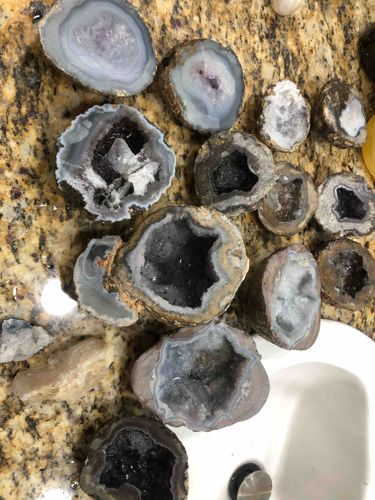
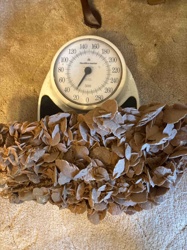
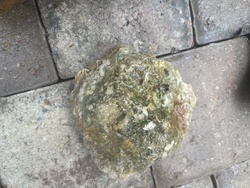
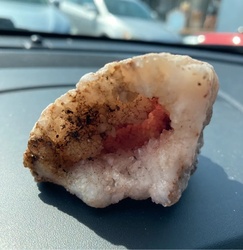
The image displays a collection of approximately 15-20 cut geodes and mineral specimens, varying significantly in size, from small, handheld pieces to larger ones that might measure several inches across. The primary material evident is quartz, appearing in various crystalline formations within the geode cavities. The exterior of many geodes retains their rough, natural rock matrix, often in shades of brown, grey, and earthy tones, indicative of their geological origins. The interior cavities reveal different types of quartz crystals. Some geodes exhibit clear, colorless quartz crystals, while others show darker, possibly smoky quartz or even black chalcedony/agate formations, as seen in the larger central geode. Several pieces display banding patterns in the surrounding agate/chalcedony layers, with colors ranging from pale blue-grey to white and reddish-brown, creating distinct concentric rings. The crystal formations vary from sparkling druzy surfaces to more defined crystal points, as observed in one of the prominent top left specimens which appears to have a larger, more defined quartz crystal growth within its cavity. No obvious maker's marks or signatures are visible, as these are natural geological formations. The condition appears to be relatively good, with the cuts appearing clean, suggesting they have been professionally or semi-professionally opened. There are no readily apparent signs of significant damage, repairs, or excessive wear beyond natural variations in the rock. The collection appears to be a diverse assortment, likely obtained from various geological sources given the differing internal crystal structures and outer matrix colors. These specimens are natural, making an 'estimated age' difficult beyond their geological formation period, which would be millions of years.
AI Appraisal Report
Based on my visual examination of the provided image, I've assessed this collection of Assorted Natural Quartz Geodes and Mineral Specimens. The collection consists of approximately 15-20 cut geodes and various quartz formations. The overall condition appears to be very good; the cuts are clean, suggesting careful opening, and I observe no significant damage, repairs, or excessive wear beyond natural geological variations. The diversity in crystal structures, matrix colors (brown, grey, earthy tones), and banding patterns (pale blue-grey, white, reddish-brown) suggests a varied origin for these natural specimens. The presence of clear quartz, smoky quartz, and black chalcedony/agate forms adds to the collection’s appeal. These are natural geological formations, so 'authenticity' is tied to their natural origin, which appears evident. There are no maker's marks, as expected for such items.
From an appraisal perspective, the market for natural mineral specimens and geodes is consistent, driven by collectors, interior decorators, and those interested in metaphysical properties. Demand is steady for visually appealing and diverse collections. While these are not exceptionally rare specimens in terms of mineral type (quartz is abundant), the quality of cuts, the diversity within the collection, and the varying crystal formations enhance their desirability. Factors impacting value include the aesthetic appeal of the crystal structures, size, and the clarity/color of the quartz. The larger pieces, particularly the prominent central one with black chalcedony, and the specimen with defined quartz crystal growth, contribute positively to the overall value.
Limitations exist without a direct physical examination. While the image suggests natural specimens, in-person examination would allow for definitive authentication of material type (e.g., distinguishing natural quartz from synthetic or treated varieties, though visually these appear natural). Physical inspection would also confirm the integrity of each piece, detect any subtle repairs not visible in the photograph, and allow for a more precise assessment of crystal quality and matrix details. Provenance documentation (e.g., where they were sourced, if known) could add a minor premium for collectors interested in specific localities, but it's not crucial for general market value of such common minerals. Scientific testing, like X-ray diffraction, would confirm mineral composition but is generally unnecessary for such visually identifiable quartz specimens unless specific anomalies were suspected.
Regarding the mention of 'Chain stamp is 14k Italy and the s stamp is 14k', this information appears to be unrelated to the appraisal of these geological specimens, as the image shows natural geodes and minerals, not jewelry items.