AI estimate as of September 13, 2025 · verify with a professional before acting
AI-Generated · Verify before acting
Everything on this page is generated by AI for informational purposes only. AI can make mistakes — the AI may misidentify items or misattribute them (artist, maker, brand, designer, origin, era). This is not an official valuation and should not be used for insurance, sale, tax, estate, legal, or lending purposes — or any decision requiring a certified appraisal. It is not an authoritative claim about any person, brand, or rights holder — do not share or rely on it as a factual statement about a third party. Always consult qualified professionals before making financial decisions.
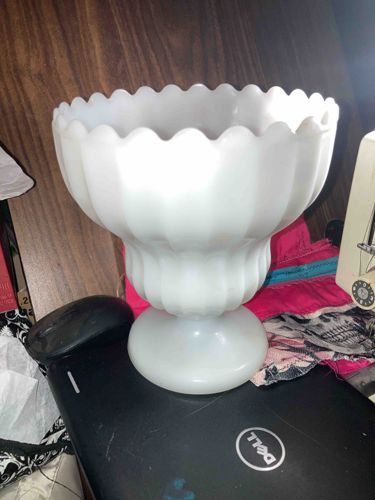
This item is a white milk glass footed bowl, often referred to as a compote or candy dish. It features a fluted or ribbed body that tapers downwards from a wide mouth to a narrower stem, which then expands into a stable, rounded foot. The most distinctive feature is the top rim, which is elaborately ruffled or scalloped, adding a decorative and classic touch. The material appears to be opaque white milk glass, known for its smooth, milky appearance and slight translucency when held up to light, though this detail is not fully discernible in the provided image. The construction seems to be of a single piece, molded glass. It exhibits a classic aesthetic, suggesting it could be from the mid-20th century or earlier, a popular period for milk glass production. No visible manufacturer's marks, signatures, or stamps are discernible in the image. The overall condition appears to be good, with no obvious chips, cracks, or significant wear visible, although a closer inspection would be required to confirm this. The quality of the craftsmanship appears standard for mass-produced milk glass of its era.
AI Appraisal Report
Upon visual examination of the provided image, this white milk glass ruffled footed bowl, or compote, appears to be in good overall condition. I observe no obvious chips, cracks, or significant wear, which is positive for its value. The opaque white milk glass material and classic ruffled rim design are characteristic of mid-20th century milk glass production, a popular period for such items. Authenticity, based solely on the image, is consistent with mass-produced milk glass from that era. The construction appears to be a single, molded piece, which aligns with typical manufacturing methods.
Market conditions for common milk glass pieces like this are generally stable but tend to be on the lower end. Comparable items, often found at antique malls, flea markets, and online platforms, usually fetch modest prices. Demand for this specific type of decorative milk glass is moderate; while there's a consistent interest from collectors of vintage glassware, the high volume of similar pieces produced means it is not particularly rare.
Factors significantly impacting value include the lack of any discernible manufacturer's marks, which would typically elevate the price if associated with a well-known maker like Fenton or Westmoreland. Without such identification, it is valued as an unmarked or generic piece. The decorative ruffled edge adds some aesthetic appeal, but it's a common feature. The primary limitation in this appraisal is the lack of physical examination. While the image suggests good condition, an in-person inspection would be needed to confirm the absence of hairline cracks, internal flaws, or minor chips not visible from the photograph, and to assess the true quality of the glass and its translucency. Full authentication would ideally involve handling the piece to check for mold lines, specific glass characteristics, and potential hidden marks. Provenance documentation would also be beneficial but is rarely available for such common items.