AI estimate as of December 8, 2025 · verify with a professional before acting
AI-Generated · Verify before acting
Everything on this page is generated by AI for informational purposes only. AI can make mistakes — the AI may misidentify items or misattribute them (artist, maker, brand, designer, origin, era). This is not an official valuation and should not be used for insurance, sale, tax, estate, legal, or lending purposes — or any decision requiring a certified appraisal. It is not an authoritative claim about any person, brand, or rights holder — do not share or rely on it as a factual statement about a third party. Always consult qualified professionals before making financial decisions.
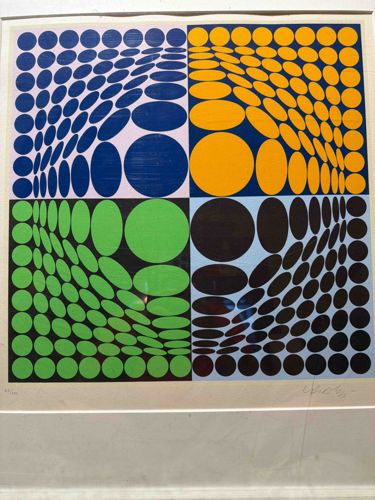
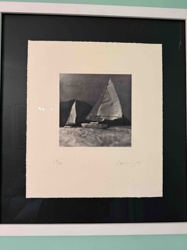
This item is an optical art print, likely a serigraph or lithograph, featuring a grid of four distinct quadrants, each designed to create a visual illusion of depth and movement through the manipulation of ellipses. The print exhibits bright, contrasting colors and a precise geometric composition typical of Op Art from the mid-20th century, specifically the 1960s or 1970s. Each quadrant is filled with rows of ellipses that transition from circular to more elongated forms, creating a 'bulging' or 'receding' effect. The top-left quadrant features dark blue ellipses on a pale pink background, while the top-right quadrant displays bright orange ellipses on a dark blue background. The bottom-left quadrant uses vibrant green ellipses against a black background, and the bottom-right quadrant has dark brown/black ellipses on a light blue background. This interplay of color and shape generates a strong sense of optical dynamism. The registration of the colors appears sharp, indicating good printing quality. In the lower-left corner, there is a handwritten edition number '67/150', suggesting this is part of a limited edition series. In the lower-right corner, there is a signature, 'Vasarely' or similar, which is characteristic of Victor Vasarely's work, a pioneer of the Op Art movement. The print is currently housed within a simple, light-colored frame, likely white or off-white. There are no immediately visible condition issues such as tears, significant creases, or water damage, though it is difficult to assess the paper's integrity or any subtle fading without closer inspection out of the frame. The overall appearance is clean and well-preserved.
AI Appraisal Report
Based on my visual examination of the provided image, this Optical Art Print displays characteristics highly consistent with the work of Victor Vasarely, a seminal figure in the Op Art movement. The precise geometric composition, the use of contrasting colors, and the illusion of depth and movement created by the manipulation of ellipses are all hallmarks of his oeuvre. The handwritten '67/150' indicates it is a limited edition print, which adds to its value. The signature, which I interpret as 'Vasarely', further strengthens this attribution.
The print appears to be in excellent condition. The colors are vibrant, and the registration is sharp, suggesting good print quality and minimal fading. I observe no visible tears, creases, or water damage within the frame. The simple light-colored frame is appropriate and appears well-maintained.
From a market perspective, Op Art, and particularly works by Vasarely, continue to command strong interest among collectors. Limited edition prints by Vasarely, especially serigraphs or lithographs from the 1960s-1970s of this scale and visual impact, typically perform well at auction and through reputable galleries. Demand for these pieces is steady, driven by both established collectors and new enthusiasts looking for accessible entry points into Modern art.
However, it is crucial to state the limitations of this appraisal based solely on an image. While the visual evidence strongly suggests authenticity, I cannot definitively authenticate the signature or the print itself without an in-person examination. A physical inspection would allow me to assess the paper type, printing technique (e.g., screenprint vs. offset lithography), confirm the nature of the signature (e.g., hand-signed vs. plate signed), and evaluate any subtle condition issues not visible in photographs, such as minor toning, foxing, or fading. Furthermore, full authentication would ideally require examination of provenance documentation, such as a certificate of authenticity or purchase records. Scientific testing, if necessary, could also confirm media and age.