AI Appraisal Estimate

AI-generated estimates · not official valuations

From the user

What was submitted

Photo and notes provided by the user — not generated by AI

Submitted item photo
Submitted photo · May 22, 2026

User's notes

Meyer

AI analysis below

AI appraisal

AI analysis & estimate

AI-Generated · Verify before acting

Everything below is generated by AI for informational purposes only. AI can make mistakes — the AI may misidentify items or misattribute them (artist, maker, brand, designer, origin, era). This is not an official valuation and should not be used for insurance, sale, tax, estate, legal, or lending purposes — or any decision requiring a certified appraisal. It is not an authoritative claim about any person, brand, or rights holder — do not share or rely on it as a factual statement about a third party. Always consult qualified professionals before making financial decisions.

Note

This analysis also relies on unverified notes provided by the user, which may be incomplete or inaccurate and could affect the result.

Read the full disclaimer

AI Identification

·Not independently authenticated·Verify before acting

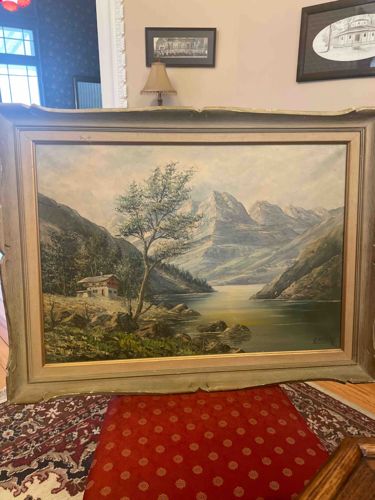
Alpine Mountain Landscape by Meyer

Fine Art - Paintings

AI Estimated Value

·Not an official valuation·Verify before acting

$400 - $650

As of May 22, 2026

AI Item Analysis

·AI can make mistakes·Verify before acting
This is a mid-20th-century oil painting on canvas depicting a serene Alpine landscape. The composition features a central, slender tree in the foreground, leading the eye toward a traditional Swiss-style chalet nestled against a rocky shoreline. In the distance, jagged, snow-dusted mountains rise above a calm reflecting lake under a pale, overcast sky. The color palette is dominated by muted earth tones, soft greens, and cool blues, indicative of a post-war European landscape style. The painting is housed in a substantial, period-appropriate wooden frame with a gesso finish, colored in an antiqued champagne or muted gold tone with a subtle linen-lined inner slip. The signature 'Meyer' appears in the lower right corner in a dark, cursive hand. Physically, the artwork shows minor signs of age-related wear, including slight craquelure consistent with oil media and some minor abrasions and dust accumulation on the frame's outer edges. The brushwork demonstrates a practiced, traditional technique with soft blending in the sky and more textured, impasto applications in the foreground foliage and rocky outcroppings. This piece represents a popular genre of mid-century decorative fine art intended for domestic interiors, reflecting a nostalgic view of the European wilderness.


AI Appraisal Report

·AI can make mistakes·Verify before acting
I have carefully examined the submitted images of the mid-20th-century Alpine oil painting signed 'Meyer'. The work displays characteristics typical of post-war European landscape painting intended for the commercial and decorative market. The technique utilizes a combination of soft atmospheric blending in the distance and localized impasto in the foreground, demonstrating the hand of a trained, likely academic artist working within a popular genre. Condition-wise, the visible craquelure is stable and consistent with the age of the canvas. The period frame adds significant aesthetic value, though the minor abrasions and dust suggest the piece has been in a domestic setting for many years without professional conservation. The 'Meyer' signature, while a common name in mid-century landscape art, aligns with the style and period, though it lacks the distinctiveness of a highly listed master artist. Market demand for mid-century traditional landscapes is currently steady but limited mostly to decorative appeal rather than investment-grade collecting. Comparable works sold at regional auctions typically fall within the $400 to $650 range, influenced heavily by the size and the quality of the frame. Limitations: This appraisal is based solely on digital images. A physical inspection is required to verify the substrate integrity and confirm there is no hidden repair or overpainting under UV light. To fully authenticate the work, provenance documentation (such as original gallery receipts) would be necessary. Scientific analysis of pigment composition would be required to rule out modern synthetic substitutes, though the visual evidence strongly suggests a mid-20th-century origin.

Get your items appraised

Instant estimates of your treasures with AI-powered appraisals

Browse More Appraisals