AI estimate as of September 8, 2025 · verify with a professional before acting
AI-Generated · Verify before acting
Everything on this page is generated by AI for informational purposes only. AI can make mistakes — the AI may misidentify items or misattribute them (artist, maker, brand, designer, origin, era). This is not an official valuation and should not be used for insurance, sale, tax, estate, legal, or lending purposes — or any decision requiring a certified appraisal. It is not an authoritative claim about any person, brand, or rights holder — do not share or rely on it as a factual statement about a third party. Always consult qualified professionals before making financial decisions.
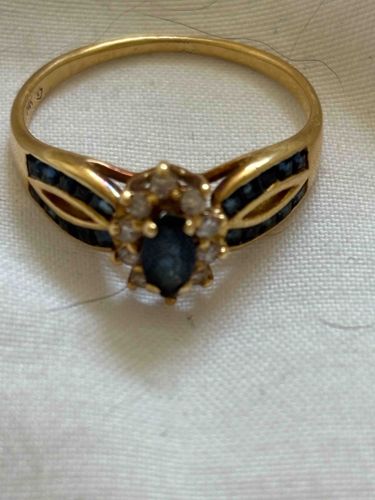
This item is a yellow gold ring featuring a central cluster setting flanked by channel-set accent stones. The ring is crafted from a warm-toned yellow metal, likely gold, given its luster and the common use of gold in jewelry of this style. The central motif consists of an oval or marquise-cut dark blue gemstone, presumed to be a sapphire, surrounded by a halo of smaller, round brilliant-cut colorless stones, which appear to be diamonds. The sapphire shows some surface wear or dust, slightly diminishing its clarity in the image. The surrounding diamonds exhibit varying degrees of sparkle, suggesting they are genuine but small. The ring's shoulders feature a channel setting with two rows of rectangular or baguette-cut dark blue stones, again likely sapphires, running down each side. These side stones appear tightly set and consistent in color with the center stone. The band is relatively slim at the back and widens towards the shoulders, exhibiting a classic ring silhouette. A faint marking, possibly a karat stamp (such as '10K' or '14K') or a maker's mark, is visible on the inner band, indicating its material purity or origin, though it is not clearly legible. The overall condition appears good with minor signs of wear consistent with regular use, such as slight surface scratches on the gold band. There is some visible dust or lint on the surface, particularly near the central sapphire and on the surrounding cloth. The craftsmanship appears to be commercially produced, with neat stone setting and a polished finish. This style of ring, featuring a central cluster with shoulder accents, was popular from the mid-to-late 20th century, suggesting an estimated age from the 1960s to 2000s.
AI Appraisal Report
Based on my visual examination of the provided image, this is a yellow gold cluster ring featuring a central oval or marquise-cut dark blue gemstone, presumed to be sapphire, encircled by small round brilliant-cut diamonds. The shoulders are channel-set with rectangular or baguette-cut dark blue stones, also likely sapphires. The overall condition appears good, consistent with a commercially produced piece showing minor signs of wear like surface scratches on the gold and some dust. The stones appear genuine, given their sparkle and color, but definitive authentication of the gemstones (sapphires and diamonds) and metal purity (e.g., 10K, 14K gold) requires in-person examination.
Market conditions for this style of ring, popular from the mid-20th century, generally place it in the vintage category with moderate demand. Comparables for similar gold, sapphire, and diamond cluster rings of this likely carat weight and quality typically range from $500 to $1,200. Factors positively impacting value include the presence of genuine sapphires and diamonds, and the gold setting. Negative factors include the small size of the diamonds, the common nature of the design, and the visible surface wear/dust on the main sapphire, which might indicate minor abrasions.
Limitations in authenticity verification are significant from images alone. I cannot confirm the exact carat weight or quality (clarity, color, cut) of the diamonds, nor the precise origin, treatment, or specific gravity of the sapphires. A faint marking is visible on the inner band, but its legibility is poor. Full authentication would require physical inspection by a gemologist, including precise measurements, magnification for clarity and inclusion assessment, spectroscopic analysis for gemstone identification and treatment detection, and acid testing or XRF analysis for metal purity. Provenance documentation, if available, would also add value and confirm origin. Without these, the appraisal value is based on visual estimation and market comparables for similar common jewelry.