AI estimate as of September 12, 2025 · verify with a professional before acting
AI-Generated · Verify before acting
Everything on this page is generated by AI for informational purposes only. AI can make mistakes — the AI may misidentify items or misattribute them (artist, maker, brand, designer, origin, era). This is not an official valuation and should not be used for insurance, sale, tax, estate, legal, or lending purposes — or any decision requiring a certified appraisal. It is not an authoritative claim about any person, brand, or rights holder — do not share or rely on it as a factual statement about a third party. Always consult qualified professionals before making financial decisions.
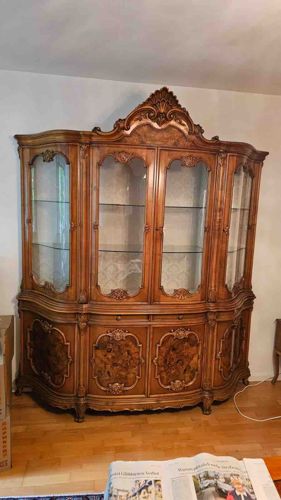
This is a large, elaborate curio or display cabinet, likely crafted from a high-quality hardwood such as walnut or a similar dark-grained wood, featuring a rich, medium-brown finish with apparent natural wood grain variations. The cabinet exhibits distinct Neoclassical or Baroque Revival influences with its symmetrical design, extensive rococo-style carving, and curved outlines.
The upper section of the cabinet features four glass-fronted doors, allowing for display of collectibles. The central two doors are slightly recessed and flanked by two angled side doors. The glass panels are set within decorative carved wooden frames. The interior appears to have glass shelves, indicating its function as a display piece. Above the central doors, a prominent, highly carved crest or pediment features scrolling acanthus leaves and shell motifs, serving as a focal point and hallmark of the ornate style.
The lower section of the cabinet is a closed storage buffet, reflecting the curved form of the upper section. It features four wooden doors, with the two central doors adorned with highly figured burl wood panels (possibly walnut or a similar veneer) set within carved frames. These panels suggest a higher quality of materials and craftsmanship. The side lower doors mimic this design. The entire piece is supported by substantial scrolled or cabriole-style feet.
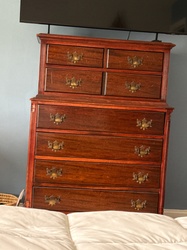
Observable condition issues appear minimal from the image, suggesting good preservation of the wood finish. There are no obvious signs of significant damage, deep scratches, or repairs, though a natural patina from age is expected. The craftsmanship appears to be of high quality, with intricate carvings and careful execution of the curved forms and joinery. The overall impression is one of grandeur and sophistication, typical of formal dining or living room furniture from the late 19th to early 20th century, or a later reproduction aiming for that aesthetic.
AI Appraisal Report
Based on my visual examination of the provided image, this Ornate Neoclassical Style Curio/Display Cabinet presents as a well-preserved, highly decorative piece. The construction appears to be substantial, likely from a quality hardwood such as walnut, evidenced by the rich, medium-brown finish and discernible grain. The extensive rococo-style carving, particularly the prominent crest and acanthus leaf motifs, along with the burl wood panels on the lower doors, indicates a high level of craftsmanship and attention to detail. Condition appears excellent from the image, with no obvious signs of significant damage, deep scratches, or repairs, suggesting careful ownership and preservation.
In terms of market conditions, large and elaborate display cabinets with clear Neoclassical or Baroque Revival influences continue to appeal to a niche market seeking traditional, stately furniture. While not always in high demand compared to more contemporary styles, well-executed examples like this maintain value. Comparables from reputable auction houses and antique dealers suggest similar pieces in excellent condition can command prices within the estimated range. Rarity is moderate; while not unique, finding such an extensively carved and well-preserved example is not common. Factors significantly impacting value include the high quality of the carving, the use of burl wood (if authentic veneer), and the overall excellent condition.
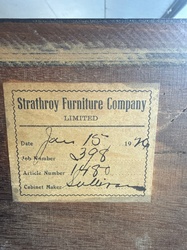
It is crucial to note the limitations of authenticity verification from images alone. Without physical inspection, I cannot definitively confirm the wood species, the age (whether it's an original late 19th/early 20th-century piece or a later, high-quality reproduction), or the presence of any hidden repairs or structural weaknesses. An in-person examination would be needed to assess joinery, wood density, internal drawer construction (if any), and the patina more closely. Provenance documentation (such as original sales receipts or family history) would further aid in authenticating its age and origin. Scientific testing, like carbon dating, is typically not practical or necessary for furniture of this presumed age but could be done for definitive material identification if disputes arose. My appraisal value assumes it is a period piece or a very high-quality reproduction.