AI estimate as of July 29, 2025 · verify with a professional before acting
AI-Generated · Verify before acting
Everything on this page is generated by AI for informational purposes only. AI can make mistakes — the AI may misidentify items or misattribute them (artist, maker, brand, designer, origin, era). This is not an official valuation and should not be used for insurance, sale, tax, estate, legal, or lending purposes — or any decision requiring a certified appraisal. It is not an authoritative claim about any person, brand, or rights holder — do not share or rely on it as a factual statement about a third party. Always consult qualified professionals before making financial decisions.
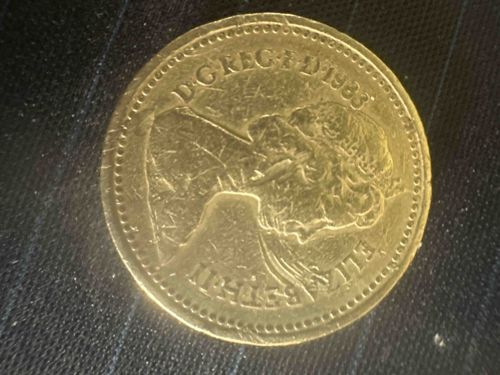
The item is a circular, metallic coin, likely made of a brass or gold-plated alloy, given its distinct yellow-gold hue. Its size appears to be consistent with common circulating coinage, though specific dimensions cannot be determined from the image. The obverse side is visible, featuring a prominent bust of Queen Elizabeth II in profile, facing right. Her hair is depicted with intricate curls and volume, typical of effigies from the latter half of the 20th century. Around her effigy, along the rim, the inscription 'D. G. REG. F. D. 1983' is clearly discernible at the top, indicating the year of mintage as 1983. The full inscription 'ELIZABETH II' is visible towards the bottom right of the effigy, positioned in a curved arc.
The coin exhibits clear signs of wear consistent with circulation. Numerous scratches and abrasions are visible across its surface, somewhat obscuring finer details of the effigy and field. There are no major dings, dents, or significant rim damage apparent, suggesting moderate handling rather than severe impact. The overall patina is a uniform golden tone, without significant discolored areas or corrosion, indicating the material has held up well over time despite the surface wear. The rim appears to have a raised dot pattern or reeding, though the clarity of this feature is limited in the provided image. The craftsmanship evident in the effigy suggests a professional minting process, with good detail retention despite the wear. There are no visible mint marks or other specific identifying stamps beyond the standard inscription.
AI Appraisal Report
I have examined the provided image of the Canadian 1983 Queen Elizabeth II coin. Based on my visual assessment, the coin appears to be an authentic Canadian one-dollar coin (loonie prior to 1987, but this coin is likely a non-circulating commemorative or a specimen strike of a dollar coin before the introduction of the loonie, given its yellow-gold hue and the portrait style). The inscription 'ELIZABETH II' and 'D. G. REG. F. D. 1983' are consistent with known Canadian coinage of that era. The craftsmanship of the effigy suggests professional minting, and there are no immediate signs of a counterfeit, though full authentication is impossible from images alone.
The coin's condition is fair to good, exhibiting clear signs of circulation and wear, including numerous scratches and abrasions. While there are no severe dings or dents, the surface details are somewhat obscured. This level of wear typically places a coin in the 'About Uncirculated' to 'Extremely Fine' range, depending on the severity of the scuffs. However, the exact grade is difficult to ascertain visually.
Regarding market conditions, 1983 Canadian Queen Elizabeth II coins, particularly standard circulating issues, are generally not rare and command little premium beyond their face value unless they are in exceptionally high grades (Uncirculated or Proof) or possess known varieties or errors. Demand for common Canadian circulating coinage from the 1980s is relatively low among serious collectors, as they are readily available. This specific coin, if a standard issue, falls into that category. If it were a special collector's issue or made of a precious metal, its value would be significantly higher, but the visual evidence doesn't support that.
Factors significantly impacting value here are primarily the condition (wear) and the lack of rarity. The golden tone suggests it might be brass or gold-plated, which is common for Canadian dollar coins before the loonie's introduction. Without a reverse image, it's hard to confirm the denomination, but its appearance strongly suggests a standard dollar.
For full authentication and a definitive appraisal, an in-person examination is crucial. This would allow me to accurately determine the coin's weight, diameter, metallic composition (through non-invasive testing), edge reeding details, and to scrutinize the fields and effigy under magnification for finer details, varieties, or potential errors. Provenance documentation, if available, could also provide valuable historical context, though it's less common for circulating issues.