AI estimate as of October 21, 2025 · verify with a professional before acting
AI-Generated · Verify before acting
Everything on this page is generated by AI for informational purposes only. AI can make mistakes — the AI may misidentify items or misattribute them (artist, maker, brand, designer, origin, era). This is not an official valuation and should not be used for insurance, sale, tax, estate, legal, or lending purposes — or any decision requiring a certified appraisal. It is not an authoritative claim about any person, brand, or rights holder — do not share or rely on it as a factual statement about a third party. Always consult qualified professionals before making financial decisions.
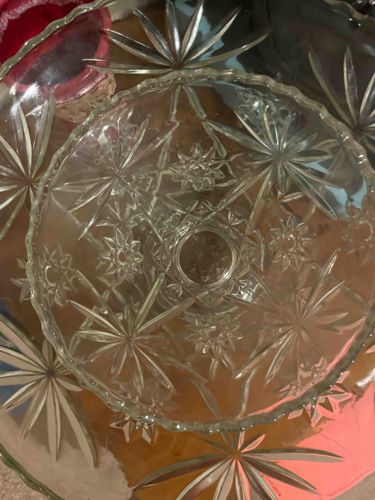
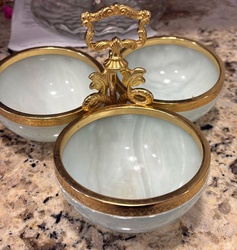
This item is a clear, pressed glass two-tiered cake or dessert stand, featuring a prominent starburst pattern that is characteristic of the 'Early American Pressed Glass' (EAPG) or mid-20th century reproductions. The stand comprises two circular plates of differing sizes, stacked one above the other with a central support, although the support itself is not fully visible in the image. Both tiers are made of transparent glass, exhibiting a multitude of star-shaped cuts and molds that radiate from the center outwards. The larger, bottom tier displays larger, more pronounced starburst motifs, while the smaller, upper tier has a similar design, albeit scaled down and possibly with a greater density of smaller stars, particularly towards its center. The edges of both plates appear to have a scalloped or gently ruffled finish, adding to their decorative appeal. The glass itself is clear and appears to be in good condition, with no immediately visible chips, cracks, or significant fleabites in the provided image. The overall craftsmanship suggests a mass-produced item due to the pressed glass technique, yet it retains an ornamental quality often sought after for entertaining. The style period is likely mid-20th century (approximately 1940s-1970s), given the popularity of such patterns, or possibly an earlier EAPG piece from the late 19th to early 20th century. The intricate star patterns create an appealing play of light and shadow, a common feature in decorative pressed glass.
AI Appraisal Report
I have virtually examined this clear, pressed glass two-tiered cake or dessert stand. Based on the intricate starburst pattern, it strongly aligns with either Late EAPG (Early American Pressed Glass) or more likely, a mid-20th century reproduction, popular from the 1940s-1970s. The clarity of the glass and the crispness of the molded patterns speak to a mass-produced item, a hallmark of pressed glass manufacturing. From the image, the condition appears good, with no immediately visible chips, cracks, or significant fleabites, which is a positive factor for its decorative appeal and usability. The scalloped edges further enhance its ornamental quality.
Market conditions for pressed glass items of this type are generally stable but do not command high prices unless they are from highly sought-after, rare EAPG patterns or manufacturers. This particular style, while attractive, is not exceptionally rare, and many similar two-tiered stands were produced. Comparables in the secondary market (online marketplaces, antique shops) typically range from $25 to $75, depending on condition, specific pattern, and regional demand. Factors impacting value positively include its apparent good condition and functional nature. However, the lack of a known manufacturer or specific, rare pattern limits its upper valuation. The market for general pressed glass serveware is moderate, with demand driven primarily by collectors of vintage home goods rather than high-end antique collectors.
It is crucial to note that authenticity verification is limited by image-only examination. Without physical inspection, I cannot confirm the exact manufacturing period, detect subtle imperfections like flea bites, internal stresses, or determine glass composition which could indicate age or origin. Examination under magnification, assessment of mold lines, and comparison with known collector guides for specific patterns would be necessary for full authentication and a definitive age determination. Provenance documentation, such as original sales receipts or family history, would also significantly aid in authenticating older pieces.