AI estimate as of October 30, 2025 · verify with a professional before acting
AI-Generated · Verify before acting
Everything on this page is generated by AI for informational purposes only. AI can make mistakes — the AI may misidentify items or misattribute them (artist, maker, brand, designer, origin, era). This is not an official valuation and should not be used for insurance, sale, tax, estate, legal, or lending purposes — or any decision requiring a certified appraisal. It is not an authoritative claim about any person, brand, or rights holder — do not share or rely on it as a factual statement about a third party. Always consult qualified professionals before making financial decisions.
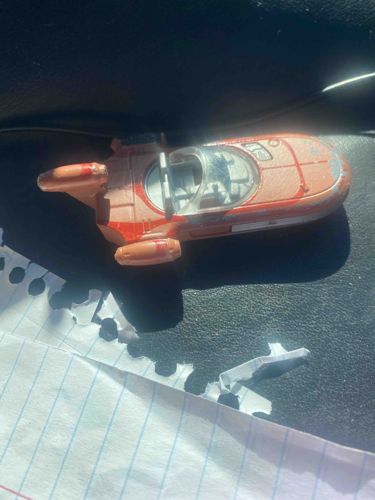
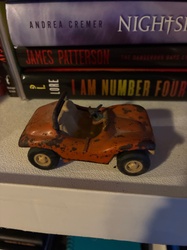
The item is a small, die-cast toy replica of a Star Wars X-34 Landspeeder, notably Luke Skywalker's vehicle from 'Star Wars: A New Hope'. It is predominantly orange and red in color, with a weathered or 'used' look, consistent with the aesthetic of the original movie props. The main body is an elongated oval shape, tapering slightly towards the front. Two distinct engine nacelles protrude from the sides, and a third, smaller one appears to be at the rear, though partially obscured. The cockpit area features a clear plastic canopy, revealing a simplistic interior with molded seats and perhaps a control panel. Red stripe details are visible on the top surface and sides of the vehicle, adding to its iconic appearance. Wear and tear are evident across the toy, including scuffs, paint loss, particularly on raised edges and corners, indicating it has been played with or handled frequently. The material appears to be painted metal (die-cast) with plastic components for the canopy and possibly some engine parts. Its size is compact, fitting easily in a child's hand. No visible manufacturing marks or signatures are discernible from the image, but it is characteristic of action figure accessory vehicles or small-scale collectible toys produced during the late 20th century, likely from the 1970s or 1980s, aligning with the initial popularity of the Star Wars franchise. The craftsmanship is typical of mass-produced toys from that era, focusing on recognizable form rather than intricate detail. One unique aspect is its status as a highly recognizable piece of pop culture memorabilia.
AI Appraisal Report
I have visually examined the Star Wars X-34 Landspeeder die-cast toy based solely on the provided image. My assessment indicates a mass-produced toy, likely from the late 1970s or early 1980s, consistent with the initial popularity of the Star Wars franchise. The authenticity appears strong as a vintage Kenner (or similar manufacturer) piece, given its design, proportions, and 'used' aesthetic, which align with known releases of this vehicle. However, without visible manufacturer markings, full authentication requires in-person examination to verify stamps, material quality, and specific production details.
Condition-wise, it presents as 'played-with'. There is apparent paint loss, scuffs, and general wear across the body, particularly on edges and raised areas. While this wear reduces its collector grade, it also adds to a nostalgic appeal for some buyers, reflecting its history. The clear plastic canopy is intact, which is a positive.
The market for vintage Star Wars toys remains robust, but condition is paramount. This particular item is not exceptionally rare; many were produced. Demand is consistent among niche collectors, but the 'used' condition dampens its top-tier value. Comparables for similar die-cast Landspeeders in good, played-with condition typically range from $30 to $60. Mint-in-box or near-mint examples command significantly more. Factors impacting this value include its recognizable pop culture status, but equally, the visible wear and the lack of original packaging or accessories.
Limitations in authenticity verification are significant from images alone. A physical examination is crucial to identify manufacturer stamps (e.g., 'G.M.F.G.I.', 'Hong Kong'), confirm materials (die-cast metal body, plastic canopy/engines), and detect any potential repairs or modifications. Provenance documentation, such as original purchase receipts or packaging, would further solidify its authenticity and potentially its value. Scientific testing is generally not required for these types of collectibles unless there are serious doubts about the materials or age.