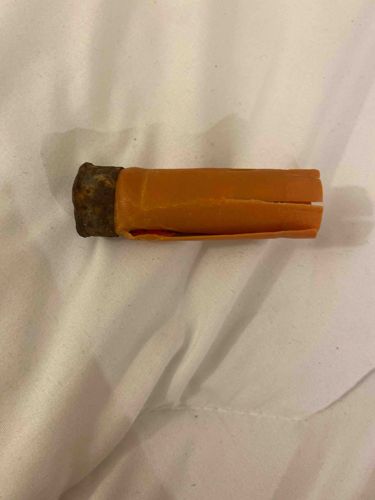
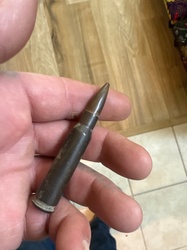
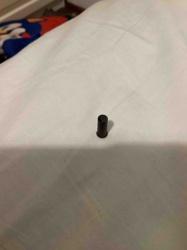
Cracked and rusted empty hunting rifle cartridge found near the Parco Archeologico di Egnazia, Italy
These notes were written by the person who submitted this item. Appraiser.AI has not verified them, and the AI's identification and estimate may rely on them.
AI Estimated Value
Not an official valuation
$0.00
AI estimate as of August 16, 2025 · verify with a professional before acting
AI-Generated · Verify before acting
Everything on this page is generated by AI for informational purposes only. AI can make mistakes — the AI may misidentify items or misattribute them (artist, maker, brand, designer, origin, era). This is not an official valuation and should not be used for insurance, sale, tax, estate, legal, or lending purposes — or any decision requiring a certified appraisal. It is not an authoritative claim about any person, brand, or rights holder — do not share or rely on it as a factual statement about a third party. Always consult qualified professionals before making financial decisions.
This analysis also relies on unverified notes provided by the user, which may be incomplete or inaccurate and could affect the result.
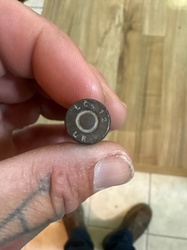
This item is an empty shotgun shell, specifically a spent hunting rifle cartridge, characterized by its bright orange plastic hull and a severely corroded brass or steel base. The overall length is relatively short, suggesting it might be a commonly used gauge like a 12-gauge or 20-gauge, although specific sizing is not discernible from the image. The plastic hull is a vibrant, almost neon, orange color, indicative of casings often used for hunting or recreational shooting, designed for visibility. Upon closer inspection, the plastic hull exhibits significant signs of wear and environmental degradation. There are multiple longitudinal cracks visible, particularly towards the open end of the shell, and a noticeable split running along its side. This damage suggests exposure to elements and possibly mechanical stress, consistent with being discovered outdoors. While no manufacturing details or maker's marks are discernible on the plastic, the heavily rusted base prevents any identification of caliber, manufacturer, or production date. The metal base is entirely covered in a thick layer of reddish-brown rust, obscuring any potential headstamp or primer details. The texture of the rust appears uneven and pitted, indicating prolonged exposure to moisture. The internal components, such as wadding or primer, are absent, confirming it is a spent and empty casing. The condition suggests it is an older piece, likely discarded after use and left exposed to the elements for a considerable period, acquiring a distressed patina. Its presence near an archeological park hints at potential historical usage in the region, perhaps from hunting activities years or decades ago. The craftsmanship is typical of mass-produced ammunition from the mid to late 20th century.
AI Appraisal Report
I have examined the image and details of this spent orange plastic shotgun shell, reportedly found near the Parco Archeologico di Egnazia, Italy. Its condition is poor; the plastic hull is severely degraded with multiple cracks and a split, and the brass/steel base is entirely obscured by thick, reddish-brown rust. This severe corrosion prevents any identification of caliber, manufacturer, or production date via headstamp. The bright orange plastic is characteristic of commercial hunting ammunition from the mid-to-late 20th century. Authenticity as a spent shotgun shell is clear from its form factor, but specific details about its origin beyond being a mass-produced item are indeterminable.
Market conditions for spent, degraded ammunition components are virtually non-existent. Such items generally hold no collectible value due to their commonality and lack of unique features or historical significance, especially in this condition. The rust and cracking indicate prolonged environmental exposure, not preservation. While its discovery near an archaeological park might suggest a slight contextual interest, this is extremely niche and does not translate into monetary value. It is not rare; similar spent shells are discarded globally daily.
Factors significantly impacting value are overwhelmingly negative: extreme degradation, complete lack of identifiable markings, and its nature as a mass-produced, disposable item. There are no comparables in the collectibles market for such an item as it lacks antique, historical, or intrinsic value.
Limitations: My assessment of condition is based solely on the provided image and description. Without in-person examination, I cannot perform a tactile assessment of material stability or further investigate the rust layer. For full authentication of its age or specific origin beyond being a modern shotgun shell, specialized material analysis (e.g., spectroscopy on the plastic or elemental analysis of the rust) would be required, along with detailed provenance documentation linking it to a specific historical event or person, which is not present here.