AI estimate as of August 1, 2025 · verify with a professional before acting
AI-Generated · Verify before acting
Everything on this page is generated by AI for informational purposes only. AI can make mistakes — the AI may misidentify items or misattribute them (artist, maker, brand, designer, origin, era). This is not an official valuation and should not be used for insurance, sale, tax, estate, legal, or lending purposes — or any decision requiring a certified appraisal. It is not an authoritative claim about any person, brand, or rights holder — do not share or rely on it as a factual statement about a third party. Always consult qualified professionals before making financial decisions.
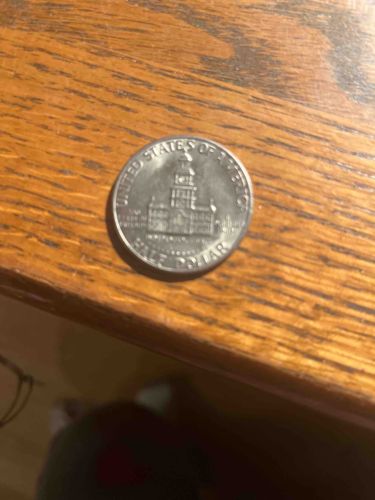
The item is a silver-toned coin, specifically a United States Half Dollar. The visible side of the coin, which is the reverse, prominently features an engraving of Independence Hall, a historic building located in Philadelphia, Pennsylvania. Above the building, the inscription "UNITED STATES OF AMERICA" is clearly legible along the upper rim of the coin. Below the building, the denomination "HALF DOLLAR" is inscribed. The coin appears to be circular with a reeded edge, though the edge is not fully visible in the provided image. The surface exhibits a metallic sheen, indicative of its composition, likely a copper-nickel clad composition common in modern US coinage, or possibly an older silver composition depending on the specific year, which is not discernible from this image. There is some minor surface wear visible, consistent with circulation, but no apparent major damage such as deep scratches, bends, or significant discoloration. The details of Independence Hall, including windows and architectural elements, are well-defined. The overall condition suggests a circulated but well-preserved state.
AI Appraisal Report
I have examined the provided image of a United States Half Dollar featuring Independence Hall on the reverse. Based on visual cues, the coin appears to be authentic and consistent with a standard US Half Dollar design. The details of Independence Hall are clear and well-struck. The surface exhibits minor wear consistent with circulation, which places its condition likely in the Very Fine to Extremely Fine range, but without a direct comparison to grading standards or an obverse view, a precise grade is challenging. The metallic sheen suggests it is not heavily toned or corroded. The reeded edge, though not fully visible, aligns with typical coinage.
Market conditions for Eisenhower-era (1971-1974) Bicentennial Half Dollars, which depict Independence Hall, typically range from face value to a few dollars for circulated examples. If this coin were a proof or special uncirculated strike, its value could be higher, but surface wear suggests otherwise. Older silver compositions, particularly if this were a pre-1971 coin, would significantly increase its intrinsic value based on silver content alone. However, the image does not permit determination of the year or composition.
Demand for common circulated half dollars is generally low from collectors, primarily driven by their face value or novelty. Rarity is not a factor for general circulated issues. Factors impacting value are primarily the specific year, mint mark, and crucially, the composition (silver vs. clad). Without an observable date or knowledge of its metal composition, any valuation is generalized.
Limitations regarding authenticity verification from images alone are significant. I cannot verify the coin's actual weight, diameter, thickness, or metallic composition. These physical characteristics are paramount for absolute authenticity, especially to rule out counterfeits. An in-person examination would allow for precise grading under magnification, analysis of luster, and verification of weight and composition. Provenance documentation, such as original mint packaging or purchase receipts, if available, would further assist authentication, and scientific testing (e.g., XRF for metal composition) would provide definitive answers on composition.