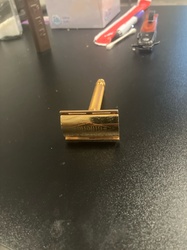
These notes were written by the person who submitted this item. Appraiser.AI has not verified them, and the AI's identification and estimate may rely on them.
AI Estimated Value
Not an official valuation
$100-200
AI estimate as of August 29, 2025 · verify with a professional before acting
AI-Generated · Verify before acting
Everything on this page is generated by AI for informational purposes only. AI can make mistakes — the AI may misidentify items or misattribute them (artist, maker, brand, designer, origin, era). This is not an official valuation and should not be used for insurance, sale, tax, estate, legal, or lending purposes — or any decision requiring a certified appraisal. It is not an authoritative claim about any person, brand, or rights holder — do not share or rely on it as a factual statement about a third party. Always consult qualified professionals before making financial decisions.
This analysis also relies on unverified notes provided by the user, which may be incomplete or inaccurate and could affect the result.
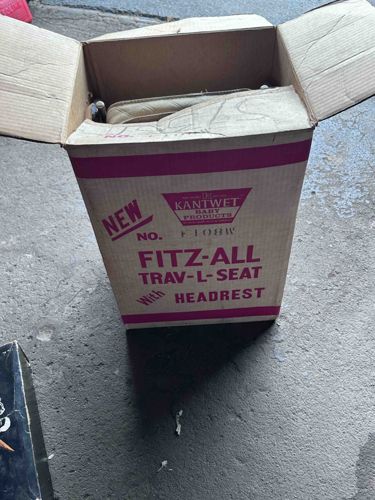
This item is a vintage 'Fitz-All Trav-L-Seat With Headrest' manufactured by Kantwet Baby Products. The item appears to be new-old-stock (NOS) and is contained within its original corrugated cardboard box. The box itself is an off-white or beige color with prominent dark pink or magenta printing. The front panel of the box clearly displays the 'KANTWET BABY PRODUCTS' logo at the top center, within a bordered rectangle. Below this, the model number 'NO. F 108W' is visible, along with the bolded text 'FITZ-ALL TRAV-L-SEAT WITH HEADREST'. The word 'NEW' is printed diagonally in the upper left corner. The box exhibits some typical wear, including visible creases on the top flaps, minor scuffs, and possibly some discoloration consistent with age and storage. The interior of the box reveals a glimpse of what appears to be the seat itself, showing a light-colored, possibly off-white or cream-colored, padded or upholstered surface. The overall construction of the packaging suggests a product from the mid-20th century, likely from the 1950s or 1960s, given the style of typography and the product's function which predates modern car seat regulations. The craftsmanship of the packaging, particularly the printing, appears functional rather than decorative, typical for utilitarian baby products of that era.
AI Appraisal Report
Based on my examination of the provided images, this Kantwet Fitz-All Trav-L-Seat with Headrest, in its original box, presents as new-old-stock (NOS). The corrugated cardboard packaging, with its distinct off-white/beige color and dark pink/magenta printing, including the 'NEW' diagonal stamp and 'NO. F 108W', strongly supports its authenticity as a vintage Kantwet product. The visible light-colored, padded interior further confirms it is likely intact.
I assess the condition of the box as good for its age, showing expected creases on flaps, minor scuffs, and potential discoloration from storage. This wear is typical for utilitarian packaging from the mid-20th century (likely 1950s-1960s), aligning with the typography and product function. The item's NOS status significantly enhances its collector appeal, as finding such vintage baby products complete in their original, well-preserved packaging is rare.
However, it is crucial to note that this item holds value purely as a vintage collectible, not as a functional child safety device. It predates modern car seat regulations and would be unsafe for use. Market demand for such specific vintage baby paraphernalia is niche but consistent among collectors of Americana, vintage advertising, and mid-century items. Comparable sales for similar NOS vintage baby travel items are infrequent but can fetch premium prices due to rarity and nostalgic appeal.
Factors impacting value include its complete, unused state and the original packaging. Without physical inspection, I cannot confirm the absolute internal condition of the seat (e.g., integrity of padding, presence of all components, material degradation) or any subtle damage to the box not visible in the images. For full authentication and a definitive condition assessment, an in-person examination would be necessary to verify materials, internal integrity, and the absence of any hidden flaws. Provenance documentation, while not available, would also aid in confirming its precise age and history.