AI estimate as of August 18, 2025 · verify with a professional before acting
AI-Generated · Verify before acting
Everything on this page is generated by AI for informational purposes only. AI can make mistakes — the AI may misidentify items or misattribute them (artist, maker, brand, designer, origin, era). This is not an official valuation and should not be used for insurance, sale, tax, estate, legal, or lending purposes — or any decision requiring a certified appraisal. It is not an authoritative claim about any person, brand, or rights holder — do not share or rely on it as a factual statement about a third party. Always consult qualified professionals before making financial decisions.
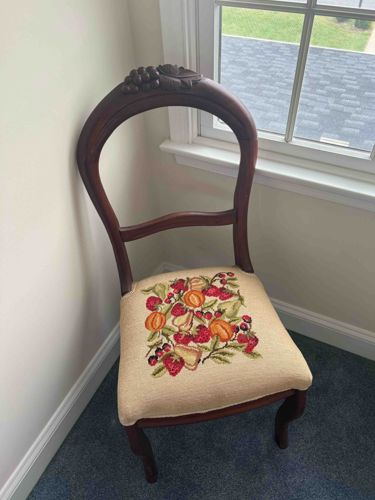
This is an antique or vintage wooden dining chair, likely a side chair given its singular appearance. The chair is crafted from a dark-stained wood, possibly mahogany or a similar hardwood, exhibiting a rich, warm brown hue that suggests a certain age and patinated finish. Its construction features a curvaceous backrest, indicating a possible Rococo Revival or Victorian influence, characterized by a rounded top rail that gracefully curves into the stiles. A notable decorative element is the carved motif at the crest of the backrest, which appears to be a cluster of grapes and leaves, adding an elegant detail typical of early-to-mid 19th-century designs or later revivals. The seat is upholstered with a needlepoint or petit point fabric featuring a vibrant, bucolic pattern of fruits and berries including red strawberries, orange apricots or peaches, and what might be slices of cake or pie. The background of the needlepoint is a light, neutral color, possibly beige or cream, which allows the colorful fruit design to stand out. The chair exhibits minimal visible wear or damage from the provided images, suggesting it has been well-maintained or recently restored. The legs appear to be curule or cabriole-style, curving outwards at the bottom, which is consistent with the era suggested by the backrest's design. The overall craftsmanship implies a handmade or semi-handmade origin, with attention to detail in the carving and the upholstery work. The quality of the needlepoint appears to be high, with dense stitching.
AI Appraisal Report
Upon examining the provided image of this Antique/Vintage Carved Wood Side Chair with Needlepoint Upholstery, my assessment is that the chair presents in remarkably good condition for its presumed age. The dark-stained wood exhibits a rich patina, indicating authentic age rather than a superficial new finish. The carved grape and leaf motif on the crest rail is well-preserved with sharp details, suggesting minimal handling wear or past repairs. The needlepoint upholstery appears vibrant and intact, displaying dense, high-quality stitching with no visible tears, unraveling, or significant fading, which is noteworthy for textile of this vintage. The overall construction appears solid, with no evident looseness in joints.
Authenticity, based purely on visual examination, suggests a piece from the mid-to-late 19th century, likely from the Rococo Revival or Aesthetic Movement period, given its curvaceous form and naturalistic carving. The quality of both the woodwork and the needlepoint points to a handcrafted or semi-mechanized origin, consistent with historical production methods.
Market conditions for antique side chairs of this style, particularly those retaining their original or period-appropriate high-quality needlepoint, are generally stable. While not exceptionally rare, a piece in such fine condition with distinctive aesthetic appeal commands interest. Comparables would include similar Victorian or Rococo Revival side chairs with original or professionally restored upholstery, often found at regional antique auctions or specialized dealers. The demand is moderate, driven by collectors and interior designers seeking unique, decorative period pieces.
Factors significantly impacting value include the excellent condition of both wood and upholstery, the appealing and detailed carving, and the charming, presumably hand-stitched needlepoint. Were the needlepoint contemporary or poorly executed, the value would be considerably lower.
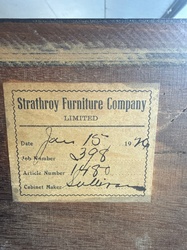
It is crucial to note the limitations of remote appraisal. Full authentication would necessitate an in-person examination to assess the wood type, construction methods (e.g., joinery), and the age of the wood and upholstery fibers. Provenance documentation, if available, such as original purchase receipts or family records, would definitively establish its history and add to its value. Scientific testing, like carbon dating for the wood, or fiber analysis for the upholstery, could provide precise age verification, though these are typically reserved for higher-value pieces or ambiguous cases.