AI estimate as of August 7, 2025 · verify with a professional before acting
AI-Generated · Verify before acting
Everything on this page is generated by AI for informational purposes only. AI can make mistakes — the AI may misidentify items or misattribute them (artist, maker, brand, designer, origin, era). This is not an official valuation and should not be used for insurance, sale, tax, estate, legal, or lending purposes — or any decision requiring a certified appraisal. It is not an authoritative claim about any person, brand, or rights holder — do not share or rely on it as a factual statement about a third party. Always consult qualified professionals before making financial decisions.
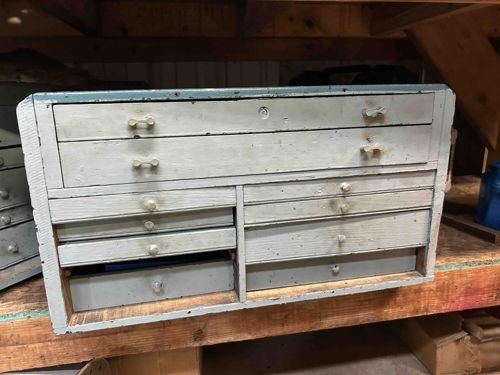
This appears to be an antique or vintage multi-drawer cabinet, likely constructed from wood, given the visible grain and wear patterns. The cabinet is rectangular in shape and features a light, possibly distressed or aged, light blueish-grey paint finish that shows significant chipping, scratching, and wear, consistent with considerable age and use. The top surface also appears to have a similar paint finish and is worn. Overall, the cabinet includes at least nine drawers of varying sizes. The top two drawers span the full width of the cabinet and are relatively deep. Below these, the cabinet is divided into two vertical sections. The left section contains three shallower drawers, while the right section holds four similar, shallower drawers. Each drawer is fitted with a single, small, turned wooden knob; the knobs also show signs of wear and paint loss. There is a single keyhole located centrally on the facade, above the top-most wide drawer, suggesting a locking mechanism for either the top drawer or potentially a master lock for all drawers. The craftsmanship appears functional and utilitarian, indicative of a piece designed for workshop, craft, or tool storage. There are no visible maker's marks or distinguishing signatures, but the style of the knobs and the overall construction suggest a period from the early to mid-20th century, possibly earlier given the level of wear. The edges and corners show scuffing and minor chips in the wood, typical of age and handling. This item exhibits a strong aged patina. The construction seems to be simple, possibly dovetailed or butt-jointed, though specific joinery is not clearly visible. The overall condition suggests a working piece that has been well-used over its lifetime, presenting a rustic, industrial, or farmhouse aesthetic.
AI Appraisal Report
Upon visual examination of this Vintage Multi-Drawer Wooden Cabinet, I assess it to be an authentic example of a well-used, early to mid-20th century utilitarian storage piece. The distressed, light blueish-grey paint, chipped and worn, along with the scuffed wooden knobs and general patina, strongly indicate its age and functional history. My assessment of its condition is 'fair' to 'good' for a vintage item; while there is significant cosmetic wear, it appears structurally sound given its long life. The keyhole suggests a locking mechanism, adding to its character.
Market conditions for vintage industrial, farmhouse, and rustic decor remain robust. Comparables in this style, particularly multi-drawer cabinets, fetch strong prices. Demand is high for pieces that offer both aesthetics and practical storage. While not rare, cabinets of this specific size and drawer configuration, with such an authentic worn finish, are less common than simpler chests. Factors significantly impacting value include its charming distressed finish, practical drawer configuration, and the overall 'story' it tells through its wear. The lack of visible maker's marks is typical for utilitarian pieces of this era and doesn't detract significantly from its value.
Limitations in authenticity verification from images alone exist. While the visual cues are strong, an in-person examination would be needed to confirm wood type, joinery techniques (e.g., dovetails), the functionality of the drawers and locking mechanism, and to rule out any repairs or structural weaknesses not visible in photographs. Provenance documentation, if available, could further authenticate its history and origin. Scientific testing, such as paint analysis or wood dating, would be excessive for a piece of this nature unless significant doubts arose regarding its age or materials.