Château Noir Reproduction
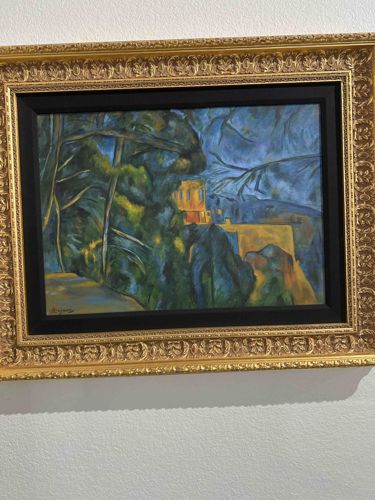
This item is an oil-on-canvas landscape painting, which appears to be a study or reproduction of Paul Cézanne's 'Château Noir.' The artwork features a Post-Impressionist style with thick, visible brushstrokes and a color palette dominated by deep blues, forest greens, and warm ochre yellows representing the stone structure. The composition focuses on a central building partially obscured by dark, expressive trees and foliage. A signature is visible in the lower-left corner, though its authenticity requires professional verification. The painting is housed in an ornate, gilded wood or composite frame featuring elaborate acanthus leaf carvings and a dark black inner fillet that provides a striking contrast transition to the canvas. The frame shows minor superficial wear consistent with age, while the canvas surface appears stable without visible cracking or pigment loss. The overall aesthetic suggests a late 20th-century creation intended to capture the geometric abstraction and tonal depth characteristic of the Provencal landscape.
AI-Generated Appraisal Disclaimer
Estimated Value
$400 - $700
Basic Information
Category
Fine Art - Paintings
Appraised On
February 28, 2026
Estimated Value
$400 - $700
Item Description
This item is an oil-on-canvas landscape painting, which appears to be a study or reproduction of Paul Cézanne's 'Château Noir.' The artwork features a Post-Impressionist style with thick, visible brushstrokes and a color palette dominated by deep blues, forest greens, and warm ochre yellows representing the stone structure. The composition focuses on a central building partially obscured by dark, expressive trees and foliage. A signature is visible in the lower-left corner, though its authenticity requires professional verification. The painting is housed in an ornate, gilded wood or composite frame featuring elaborate acanthus leaf carvings and a dark black inner fillet that provides a striking contrast transition to the canvas. The frame shows minor superficial wear consistent with age, while the canvas surface appears stable without visible cracking or pigment loss. The overall aesthetic suggests a late 20th-century creation intended to capture the geometric abstraction and tonal depth characteristic of the Provencal landscape.

Related Tags
Explore similar items and categories:
Get Your Items Appraised
Instant estimates of your treasures with AI-powered instant appraisals