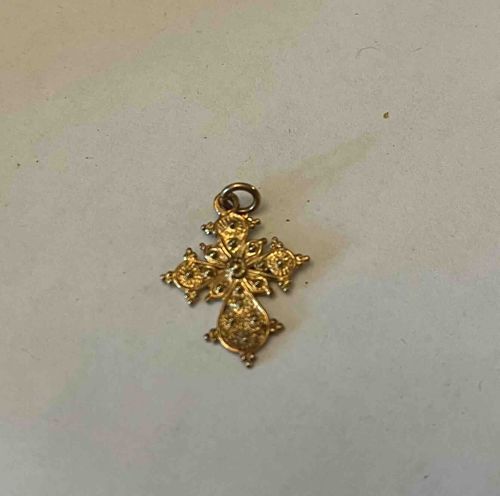
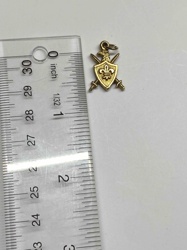
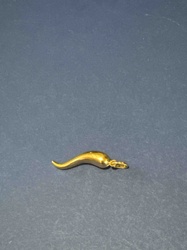
14 k gold Greek cross approximately 1.75 cm x 2.25 cm
These notes were written by the person who submitted this item. Appraiser.AI has not verified them, and the AI's identification and estimate may rely on them.
AI Estimated Value
Not an official valuation
$150-250
AI estimate as of July 21, 2025 · verify with a professional before acting
AI-Generated · Verify before acting
Everything on this page is generated by AI for informational purposes only. AI can make mistakes — the AI may misidentify items or misattribute them (artist, maker, brand, designer, origin, era). This is not an official valuation and should not be used for insurance, sale, tax, estate, legal, or lending purposes — or any decision requiring a certified appraisal. It is not an authoritative claim about any person, brand, or rights holder — do not share or rely on it as a factual statement about a third party. Always consult qualified professionals before making financial decisions.
This analysis also relies on unverified notes provided by the user, which may be incomplete or inaccurate and could affect the result.
This item is a small 14k gold Greek cross pendant or charm, exhibiting a classic cross form where all four arms are of equal length. The overall dimensions are approximately 1.75 cm in width by 2.25 cm in length, including the bale. The material is specified as 14k gold, which is consistent with the rich yellow metallic luster visible in the image. The cross features a textured, possibly filigree or granulated surface on its arms and central boss, giving it a decorative and ornate appearance. Each arm of the cross, as well as the center, has a raised, perhaps bezel-set, element with a granular or stippled texture within, suggesting a classic or historical design influence, possibly Byzantine or early Christian art. The four points of the cross also feature a similar raised, possibly bead-like, decoration. The craftsmanship appears to be detailed, with a focus on surface embellishment. There is a small jump ring or bail at the top arm for suspension on a chain or bracelet. Visible condition issues include some general surface wear and a slight accumulation of dirt or patina in the recessed areas, which is typical for an item of this age and material. No specific maker's marks or signatures are discernable from the provided image. The style suggests it could be from the mid-20th century or earlier, referencing traditional religious jewelry designs. Its small size and lightweight appearance suggest it was likely intended as a personal devotional item or a symbolic accessory.
AI Appraisal Report
Based on my visual examination of the provided image and the owner's description, I assess this item as a 14k gold Greek cross charm/pendant. Authenticity for the 14k gold content, while visually consistent with typical yellow gold, cannot be definitively confirmed without precious metal testing. The craftsmanship appears genuine for its described style, with detailed surface embellishment. Condition wise, I observe general surface wear and some accumulation of dirt/patina in recessed areas, which is typical for an item of its presumed age. These minor issues do not significantly detract from its overall appeal or value.
In terms of market conditions, religious jewelry, especially pieces with historical design influences like Byzantine or early Christian art, consistently finds buyers. Comparables for 14k gold charms of this size typically range based on weight, design complexity, and aesthetic appeal. Given its detailed, ornate workmanship, it holds more intrinsic value than a plain cross. Demand for such pieces is steady, driven by both collectors and individuals seeking symbolic jewelry. While not exceptionally rare, its specific design details add to its desirability.
Factors significantly impacting value include the confirmed gold purity (14k), its appealing, detailed design, and its good overall visual condition despite minor wear. The small size, while limiting the gold weight, makes it versatile for wear.
It is crucial to note that while I can assess visual authenticity and craftsmanship from images, full authentication requires a physical examination. Specifically, an in-person assessment would allow for a precise measurement of its weight (critical for calculating intrinsic gold value), confirmation of the karats through XRF (X-ray fluorescence) or acid testing, and a thorough inspection for any maker's marks or hallmarks not discernible in the image. Provenance documentation, if available, would further enhance its historical and potential monetary value.