AI Appraisal Estimate

AI-generated estimates · not official valuations

From the user

What was submitted

Photo and notes provided by the user — not generated by AI

Submitted item photo
Submitted photo · May 26, 2026

User's notes

No additional notes provided.

AI analysis below

AI appraisal

AI analysis & estimate

AI-Generated · Verify before acting

Everything below is generated by AI for informational purposes only. AI can make mistakes — the AI may misidentify items or misattribute them (artist, maker, brand, designer, origin, era). This is not an official valuation and should not be used for insurance, sale, tax, estate, legal, or lending purposes — or any decision requiring a certified appraisal. It is not an authoritative claim about any person, brand, or rights holder — do not share or rely on it as a factual statement about a third party. Always consult qualified professionals before making financial decisions.

Read the full disclaimer

AI Identification

·Not independently authenticated·Verify before acting

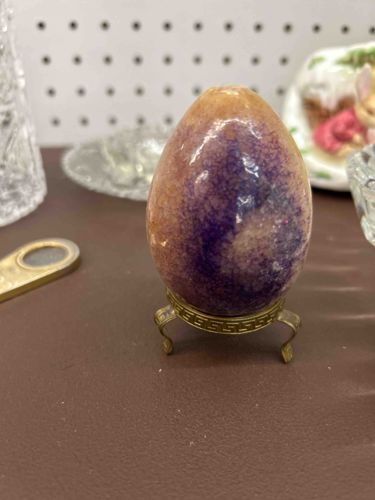
Carved Alabaster or Stone Decorative Egg with Brass Stand

Decorative Collectibles / Stone Art

AI Estimated Value

·Not an official valuation·Verify before acting

$45.00 - $65.00

As of May 26, 2026

AI Item Analysis

·AI can make mistakes·Verify before acting
This decorative object consists of a hand-carved, ovoid-shaped stone egg resting on a small, three-footed brass pedestal. The egg appears to be crafted from alabaster or a similar translucent stone, which has been treated with a deep purple dye to create a mottled, marbled effect across its surface. The coloration ranges from natural creamy tan and amber tones to a saturated violet. The surface is polished to a high-gloss finish, reflecting ambient light. The egg measures approximately 2.5 to 3 inches in height. The accompanying stand is made of cast brass or a similar alloy, featuring a classic Greek key (meander) pattern around the rim and curved, tripod-style legs. The stand shows a significant aged patina, with dark oxidation visible in the recessed areas of the design. There are no visible maker's marks or signatures on the surface. Condition-wise, the stone remains smooth without significant chips, though the top point shows slight flattening which may be an original carving feature or minor wear. The style is representative of mid-to-late 20th-century decorative collectibles, often sold as souvenirs or giftware during the 1960s through the 1980s. The craftsmanship of the stand suggests mass-produced quality, while the egg showcases the unique crystalline structure of the natural stone beneath the topical dye.
AI Appraisal Report

·AI can make mistakes·Verify before acting
I have conducted a visual examination of the purple-dyed stone egg and brass tripod stand. The egg appears to be carved from travertine or alabaster, which has been treated with a topical aniline dye to achieve its saturated violet color. Based on the 2.5–3 inch scale and the Greek key motif on the cast brass stand, this set is consistent with giftware produced in Italy or Pakistan during the 1970s and 1980s. The condition is excellent; the slight flattening at the apex appears to be a natural artifact of the lathe-turning process rather than post-production damage. The stand shows desirable natural oxidation which confirms its age as a vintage piece rather than a modern reproduction. The market for these mid-century stone eggs remains stable but saturated. They are widely available through secondary markets such as Etsy and eBay, where similar specimens frequently realize prices between $35 and $75 depending on the rarity of the stone color. The dyed purple variety is slightly more sought after than natural beige, but it lacks the premium associated with rare minerals like lapis lazuli or malachite. The mass-produced nature of the brass stand indicates this was a commercial decorative item rather than a one-of-a-kind artist commission. Limitations of this appraisal include the inability to verify the exact mineral composition or the depth of the dye strike. An in-person scratch test or UV light exposure would be required to rule out resin-based imitations, though the crystalline structure visible suggests genuine stone. No provenance was provided; documentation regarding the original retailer would clarify its origin but is unlikely to significantly alter the market value.

Get your items appraised

Instant estimates of your treasures with AI-powered appraisals

Browse More Appraisals