AI estimate as of October 8, 2025 · verify with a professional before acting
AI-Generated · Verify before acting
Everything on this page is generated by AI for informational purposes only. AI can make mistakes — the AI may misidentify items or misattribute them (artist, maker, brand, designer, origin, era). This is not an official valuation and should not be used for insurance, sale, tax, estate, legal, or lending purposes — or any decision requiring a certified appraisal. It is not an authoritative claim about any person, brand, or rights holder — do not share or rely on it as a factual statement about a third party. Always consult qualified professionals before making financial decisions.
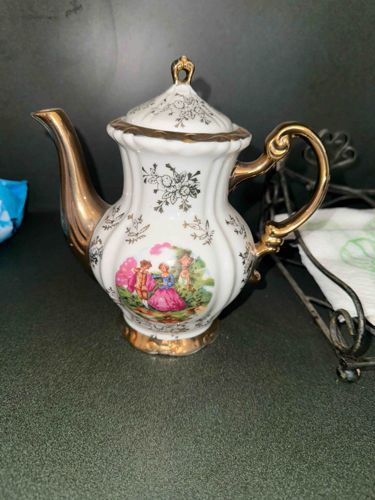
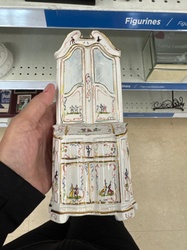
This is a small, decorative ceramic or porcelain teapot, likely intended for display, demitasse servings, or as a collectible rather than everyday use. Its primary color is white, adorned with intricate gold-colored accents and painted vignettes. The teapot features a fluted or paneled body, giving it a somewhat scalloped contour. The spout and handle are both finished in a bright, reflective gold tone, contrasting beautifully with the white body. The handle is C-shaped, with a rococo-inspired flourish where it attaches to the body. The lid is similarly white with gold trim along its edge and a small, ornate gold finial. The body of the teapot is decorated with delicate black and gold floral or foliate patterns, interspersed with a polychrome transfer-print scene depicting what appears to be a pastoral gathering or a courting couple in 18th-century European attire. This central scene features vibrant pinks, blues, and greens. The base of the teapot is also edged with a band of gold. The overall aesthetic suggests a Victorian or Rococo Revival style, possibly dating from the mid-20th century. Visible condition appears good, with no obvious chips, cracks, or significant wear to the gilding, although exact condition cannot be fully assessed without closer inspection. The craftsmanship indicates mass production but with attention to decorative detail, typical of many ornamental ceramic pieces. The small size suggests it might be a child's toy, a miniature for a dollhouse setting, or an ornamental piece for a display cabinet. The decorative style is quite elaborate, which can be an indicator of it being a gift item or souvenir. No manufacturing marks are discernible from the provided images.
AI Appraisal Report
This decorative porcelain teapot, likely a demitasse or ornamental piece, presents in good overall visual condition. The white body with intricate gold accents and polychrome transfer-printed pastoral scene is consistent with a Victorian or Rococo Revival style, likely mid-20th century production. The gilding on the spout, handle, and trim appears largely intact and reflective, suggesting careful handling or display. No obvious chips, cracks, or significant crazing are discernible from the image, but a thorough in-person inspection would be necessary to confirm this. The delicate floral patterns and central vignette are well-preserved, adding to its decorative appeal.
Market analysis for such decorative ceramic teapots indicates a moderate demand from collectors of ornamental porcelain, miniature tea sets, or Rococo-style decorative items. While aesthetically pleasing, the absence of manufacturer's marks and the likely mass-produced nature (indicated by the transfer print and general decorative style typical of later era ceramics) temper its rarity. Comparable items, often unsigned or from less prominent factories, typically sell in the $60-$100 range, depending on condition and intricate detailing. Factors impacting value positively include the excellent preservation of gilding and the charming, detailed scene. However, the lack of provenance and definitive maker's marks, coupled with potentially later production, prevent it from reaching higher values associated with antique or named-maker pieces.
Limitations to authenticity verification from images alone are significant. I cannot physically assess the weight, texture, or internal condition. Micro-inspection for hairline cracks, touch-ups, or manufacturing flaws is impossible. An in-person examination would involve checking for marks under the base (which could be obscured by wear or simply absent), evaluating the quality of the ceramic body, and confirming the application method of the decoration (hand-painted vs. solely transfer-print). Provenance documentation would be crucial to determine its age definitively and any potential maker, which would significantly impact value.