AI Appraisal Estimate

AI-generated estimates · not official valuations

From the user

What was submitted

Photo and notes provided by the user — not generated by AI

Submitted item photo
Submitted photo · May 18, 2026

User's notes

No additional notes provided.

AI analysis below

AI appraisal

AI analysis & estimate

AI-Generated · Verify before acting

Everything below is generated by AI for informational purposes only. AI can make mistakes — the AI may misidentify items or misattribute them (artist, maker, brand, designer, origin, era). This is not an official valuation and should not be used for insurance, sale, tax, estate, legal, or lending purposes — or any decision requiring a certified appraisal. It is not an authoritative claim about any person, brand, or rights holder — do not share or rely on it as a factual statement about a third party. Always consult qualified professionals before making financial decisions.

Read the full disclaimer

AI Identification

·Not independently authenticated·Verify before acting

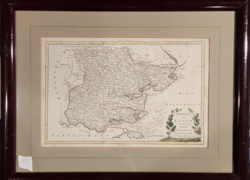
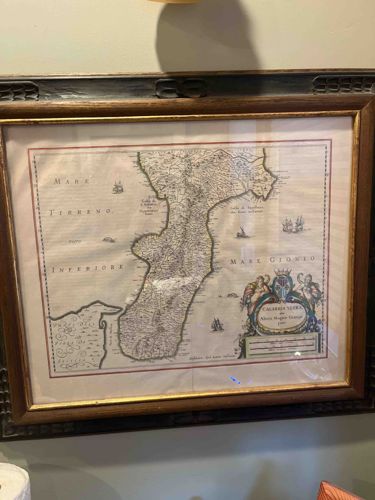
Calabria Citra framed antique-style map

Antiques & Collectibles - Cartography

AI Estimated Value

·Not an official valuation·Verify before acting

$150 - $250

As of May 18, 2026

AI Item Analysis

·AI can make mistakes·Verify before acting
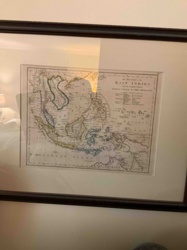
This item is a framed, hand-colored map of 'Calabria Citra' (Northern Calabria, Italy), originally based on the cartographic work of Magini. The map depicts the southern Italian peninsula flanked by the 'Mare Tirreno Inferiore' to the west and the 'Mare Ionio' to the east. It features a detailed topographical rendering of the mountainous interior, coastal towns, and several small sailing vessels in the surrounding waters. A prominent, decorative cartouche is located in the bottom right corner, featuring a coat of arms flanked by two figures and a crown, with the title 'CALABRIA CITRA ol: Altera Magna Græcia pars' inscribed within. The map is printed on what appears to be a light-colored paper which shows significant signs of rippling or 'cockling,' likely due to humidity or improper mounting. There is a visible horizontal fold line across the center typically found in maps originally bound in atlases. It is housed under glass in a traditional dark wood frame with a gilded inner lip. The frame shows minor surface wear. While the design is based on 17th-century cartography, the brightness of the colors and the crispness of certain lines suggest this could be a high-quality mid-20th-century reproduction or a well-preserved later strike, as an original 1600s engraving would typically exhibit deeper foxing and more distinct copperplate indentations not readily visible here.
AI Appraisal Report

·AI can make mistakes·Verify before acting
I have carefully examined the provided visual evidence of the 'Calabria Citra' framed map. The piece displays classic decorative features of 17th-century cartography, specifically the influence of Giovanni Antonio Magini. However, several visual markers lead me to conclude this is a mid-20th-century high-quality reproduction rather than a first-edition 1600s copperplate engraving. The coloration remains remarkably vibrant without the characteristic oxidative 'greening' of antique verdigris pigments, and the 'cockling' or rippling of the paper suggests a modern wood-pulp or lighter-weight stock susceptible to humidity, rather than the heavy, laid rag paper used in the 17th century. The central fold is consistent with atlas-bound maps, but the lack of visible plate marks (the indentation from the copper plate) is a strong indicator of a lithographic or offset print process. The current market for decorative antique-style maps is steady, but values are strictly capped for reproductions. Genuine Magini engravings of this region typically command $600 to $900 in fine condition, whereas late-period strikes or commemorative reproductions are valued primarily for their decorative appeal. The frame, while fitting the aesthetic, shows minor wear and the paper rippling slightly detracts from the overall presentation. From images alone, definitive authentication of the paper’s chemistry or watermark is impossible. To move this into a higher valuation bracket, an in-person inspection would be required to verify the presence of laid lines, chain lines, and the specific ink-to-paper depth. I would also recommend opening the frame to check for any hidden publisher marks or acid-free mounting. Without provenance or scientific paper analysis, it must be valued as a decorative reproduction.

Get your items appraised

Instant estimates of your treasures with AI-powered appraisals

Browse More Appraisals