AI Appraisal Estimate

AI-generated estimates · not official valuations

From the user

What was submitted

Photo and notes provided by the user — not generated by AI

Submitted item photo
Submitted photo · May 28, 2026

User's notes

Made in Japan

AI analysis below

AI appraisal

AI analysis & estimate

AI-Generated · Verify before acting

Everything below is generated by AI for informational purposes only. AI can make mistakes — the AI may misidentify items or misattribute them (artist, maker, brand, designer, origin, era). This is not an official valuation and should not be used for insurance, sale, tax, estate, legal, or lending purposes — or any decision requiring a certified appraisal. It is not an authoritative claim about any person, brand, or rights holder — do not share or rely on it as a factual statement about a third party. Always consult qualified professionals before making financial decisions.

Note

This analysis also relies on unverified notes provided by the user, which may be incomplete or inaccurate and could affect the result.

Read the full disclaimer

AI Identification

·Not independently authenticated·Verify before acting

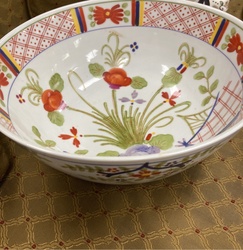
Japanese Blue and White Porcelain Bowl with Floral and Leaf Motif

Asian Ceramics and Porcelain

AI Estimated Value

·Not an official valuation·Verify before acting

$150 - $250

As of May 28, 2026

AI Item Analysis

·AI can make mistakes·Verify before acting
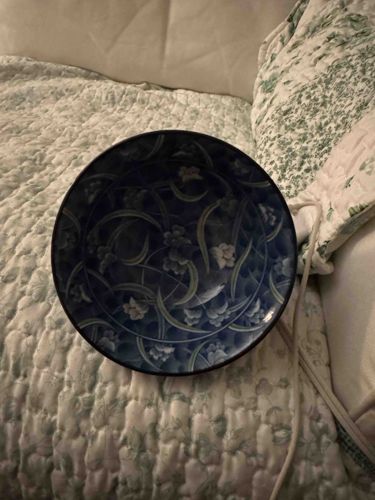
This is a circular Japanese porcelain bowl featuring a dense underglaze blue decorative scheme. The interior is adorned with an intricate, flowing pattern of stylized white flowers (likely cherry blossoms or plum blossoms) interspersed with long, arched green-tinted leaves against a multi-toned blue background of overlapping curvilinear forms. The color palette consists of deep cobalt blues, softer cerulean washes, and pale green accents on a white porcelain body. The bowl appears to be medium-sized, approximately 6 to 8 inches in diameter. The construction shows high-quality craftsmanship with a smooth, glazed finish and a defined dark rim that provides a crisp border to the internal artwork. In terms of condition, the bowl appears well-preserved with no immediate signs of cracks, major chips, or significant crazing visible in the high-contrast central well. Minimal shelf wear may be present on the unglazed foot ring, which is typical for such pieces. Based on the style and craftsmanship, this item appears to be a contemporary or mid-to-late 20th-century production, possibly Arita or Seto ware, reflecting traditional Japanese aesthetic sensibilities. The depth of the blue tones and the precision of the resist-style floral patterns indicate a professional manufacturing process often associated with export-quality Japanese ceramics.
AI Appraisal Report

·AI can make mistakes·Verify before acting
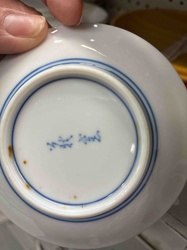
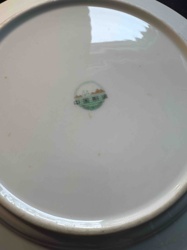
Upon my visual examination of this Japanese blue and white porcelain bowl, I find it to be a fine example of 20th-century craftsmanship, likely originating from the Arita or Seto regions. The underglaze cobalt decoration is skillfully applied using a stencil or resist technique, creating a vibrant 'vibrant floral and scrolling leaf' motif. The density of the pattern and the deep saturation of the blues suggest a professional manufacture, typical of high-quality export or domestic giftware from the mid-to-late Showa period. The condition appears excellent; the glaze maintains a high luster, and the darkened rim is intact without visible chipping. The market for mid-century Japanese ceramics remains steady, though these pieces are not as scarce as Edo-period predecessors. Comparables for such 'Imari-style' or Arita-ware bowls sold in galleries and specialized online auctions typically range between $100 and $300 depending on the size and presence of a maker's mark. While the high-quality finish is evident, valuation is moderated by the likely mass-produced nature of this specific pattern. This appraisal is based solely on digital images. A physical inspection is required to definitively assess the foot ring for specific kiln marks and to check for hidden restorations using UV light. To fully authenticate the piece as a specific designer ware, provenance records or original wooden storage boxes (tomobako) would be necessary. Without a physical signature or mark on the base, the attribution remains centered on general regional production style.

Get your items appraised

Instant estimates of your treasures with AI-powered appraisals

Browse More Appraisals