These notes were written by the person who submitted this item. Appraiser.AI has not verified them, and the AI's identification and estimate may rely on them.
AI Estimated Value
Not an official valuation
$40 - $70
AI estimate as of October 1, 2025 · verify with a professional before acting
AI-Generated · Verify before acting
Everything on this page is generated by AI for informational purposes only. AI can make mistakes — the AI may misidentify items or misattribute them (artist, maker, brand, designer, origin, era). This is not an official valuation and should not be used for insurance, sale, tax, estate, legal, or lending purposes — or any decision requiring a certified appraisal. It is not an authoritative claim about any person, brand, or rights holder — do not share or rely on it as a factual statement about a third party. Always consult qualified professionals before making financial decisions.
This analysis also relies on unverified notes provided by the user, which may be incomplete or inaccurate and could affect the result.
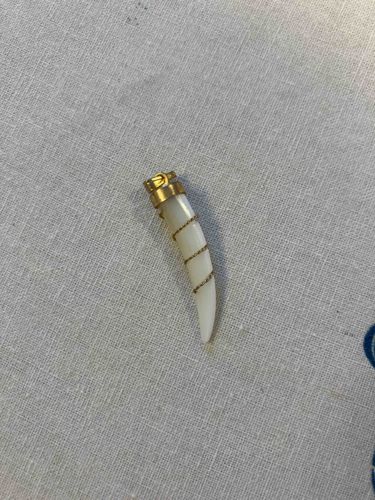
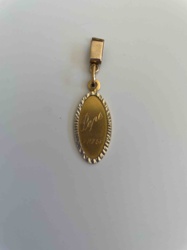
This item is a small pendant, often referred to as an Italian horn or 'corno', crafted in an elegantly curved, conical shape. Its primary material appears to be a polished white, bone-like or ivory-like substance, possibly synthetic ivory, plastic, or a natural material such as shell or bone, given its smooth, slightly translucent surface. The color is a consistent creamy white throughout the body, tapering to a fine point. The general size is relatively small, likely designed to be worn as a charm or amulet on a necklace or bracelet.
Enhancing the main body is a delicate, thin wire, appearing to be crafted from gold or a gold-tone metal, which is meticulously wrapped around the horn in a spiral pattern. This intricate winding starts near the top, just below the bail, and extends downwards along the length of the horn, providing a decorative and structural embellishment. The wire exhibits a subtle gleam, indicative of a metal with good reflectivity.
At the wider, top end of the horn, there is a substantial metal cap and bail assembly. This cap, also appearing to be made of gold or gold-tone metal, securely encases the end of the horn, integrating it with a small, circular jump ring or bail. This bail is designed for threading a chain or cord, indicating its use as a wearable piece of jewelry. The metal components, both the wire and the cap/bail, show no significant signs of tarnishing or wear, suggesting either careful preservation or that the item is relatively new or composed of durable materials.
Observable condition issues are minimal; there are no visible cracks, chips, or major abrasions on the white body or the metalwork. The item appears to be in very good, well-maintained condition. While precise manufacturing details like maker's marks are not discernible from the image, the craftsmanship of the wire wrapping and the secure attachment of the bail suggest a commercially produced piece, likely from the mid to late 20th century or more contemporary. The overall aesthetic points to an item of moderate quality, often associated with symbolic jewelry, possibly for good luck or protection.
AI Appraisal Report
Based on my visual examination of the provided image, I assess this Italian Horn (Corno) pendant to be in very good condition. There are no visible cracks, chips, or significant abrasions on the main body or the metal components. The white, conical body appears to be a polished, possibly synthetic, material, given its consistent creamy white color and smooth finish. Without physical inspection or specific tests, it's difficult to definitively ascertain if it's plastic, resin, bone, or a synthetic ivory substitute, which significantly impacts value. The finely wrapped gold-tone wire and cap/bail assembly show good craftsmanship and no signs of tarnishing, suggesting either a durable plating or a relatively new piece.
Market conditions for Italian horn pendants are generally stable, with a wide range of pricing depending on material authenticity and precious metal content. Comparable items crafted from synthetic materials with gold-tone findings typically fall into a lower price bracket. Demand is consistent for symbolic jewelry of this type, often bought for personal adornment or as good-luck charms. However, this specific item does not present any indicators of rarity.
The primary factors impacting its value are the unknown material composition of the horn and the metal content of the wire and bail. If the horn were genuine ivory or coral, and the metal were solid gold, the value would be substantially higher. However, based on the visual evidence suggesting possibly synthetic materials and gold-tone metal, the appraisal reflects a costume jewelry piece.
Limitations in authenticity verification are significant from images alone. A physical examination is crucial to determine the exact material of the horn (e.g., using density tests for bone/ivory vs. plastic, or specific gravity tests). XRF testing would be needed to confirm the precise metal composition (karatage of gold, or if it's merely plated). Provenance documentation regarding its origin and materials would also provide greater certainty for a more precise valuation.