AI Appraisal Estimate

AI-generated estimates · not official valuations

From the user

What was submitted

Photo and notes provided by the user — not generated by AI

Submitted item photo
Submitted photo · May 28, 2026

User's notes

No additional notes provided.

AI analysis below

AI appraisal

AI analysis & estimate

AI-Generated · Verify before acting

Everything below is generated by AI for informational purposes only. AI can make mistakes — the AI may misidentify items or misattribute them (artist, maker, brand, designer, origin, era). This is not an official valuation and should not be used for insurance, sale, tax, estate, legal, or lending purposes — or any decision requiring a certified appraisal. It is not an authoritative claim about any person, brand, or rights holder — do not share or rely on it as a factual statement about a third party. Always consult qualified professionals before making financial decisions.

Read the full disclaimer

AI Identification

·Not independently authenticated·Verify before acting

Mold Infestation on Ceiling and Wall Above Window

Environmental Hazard/Building Damage

AI Estimated Value

·Not an official valuation·Verify before acting

$3,000 - $6,000

As of May 28, 2026

AI Item Analysis

·AI can make mistakes·Verify before acting
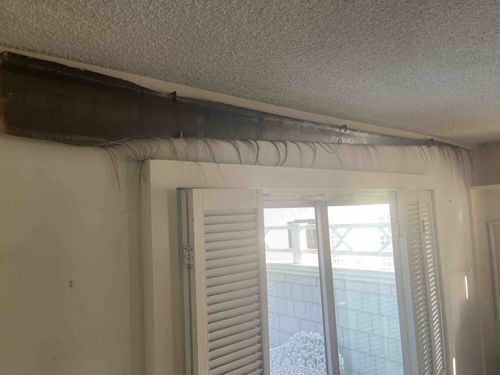
The image displays a significant fungal growth, specifically black mold, visible on the ceiling and the wall directly above a window. The primary area of infestation appears to be a linear strip across the top of the window frame, extending onto the textured popcorn ceiling and down the wall. The mold exhibits a dark, almost black coloration, with long, fibrous or hair-like growths dangling prominently from the affected surfaces, indicative of an advanced stage of infestation. These tendrils, varying in length, suggest a high moisture environment favorable for mold development. The discoloration on the ceiling itself runs parallel to the window, appearing as a dark, irregular streak against the lighter off-white or beige ceiling color. The wall below the mold, which is also a light off-white or beige, shows some faint streaking and discoloration, possibly due to prolonged moisture exposure or initial stages of mold development. The window itself is a multi-pane design with white louvered shutters on either side, which appear clean in comparison to the heavily affected area above. The overall condition suggests a chronic water leak or condensation issue originating from above the window, leading to extensive mold growth. No visible repairs or markings are discernible on the mold itself. The estimated age of the infestation appears to be substantial, given the advanced fibrous growth. The craftsmanship is naturally poor, as this is an environmental hazard rather than a manufactured item.
AI Appraisal Report

·AI can make mistakes·Verify before acting
Upon visual examination of the provided image, I observe a severe mold infestation, likely Stachybotrys chartarum (black mold), on the ceiling and wall directly above a window. The condition is critical; the presence of long, fibrous, dangling growths indicates an advanced stage of infestation, suggesting a prolonged period of high moisture. This is not an item to be valued positively, but rather an environmental hazard requiring costly remediation. The estimated age of the infestation appears substantial, likely months to years, given the extensive growth. Craftsmanship is not applicable here as this is a biological growth resulting from building damage or neglect. Market conditions for environmental hazards like severe mold abatement dictate that costs are driven by the scope of removal and repair. Comparables involve similar biohazard remediation projects. There is no positive 'demand' for such an item; rather, there is an urgent 'need' for professional intervention. The rarity is low as mold infestations are unfortunately common, but the severity seen here is significant. Factors significantly impacting the 'value' (cost of remediation) include the extensive area affected, the likely need for professional containment, removal of contaminated drywall and ceiling materials, remediation of the structural elements beneath, and subsequent reconstruction. The potential health risks associated with black mold further elevate the urgency and cost. Limitations in authenticity verification from images alone include the inability to definitively identify the specific mold species (which requires laboratory testing), assess the full extent of hidden damage within walls/ceiling, or determine the underlying cause of moisture intrusion. A direct, in-person examination would involve moisture meter readings, air quality testing, sampling for lab analysis, and opening up affected areas to assess structural integrity and hidden mold growth. Provenance documentation would be irrelevant for this type of hazard.

Get your items appraised

Instant estimates of your treasures with AI-powered appraisals

Browse More Appraisals