AI Appraisal Estimate

AI-generated estimates · not official valuations

From the user

What was submitted

Photo and notes provided by the user — not generated by AI

Submitted item photo
Submitted photo · May 23, 2026

User's notes

Hot Point Hughes Electric 1923

AI analysis below

AI appraisal

AI analysis & estimate

AI-Generated · Verify before acting

Everything below is generated by AI for informational purposes only. AI can make mistakes — the AI may misidentify items or misattribute them (artist, maker, brand, designer, origin, era). This is not an official valuation and should not be used for insurance, sale, tax, estate, legal, or lending purposes — or any decision requiring a certified appraisal. It is not an authoritative claim about any person, brand, or rights holder — do not share or rely on it as a factual statement about a third party. Always consult qualified professionals before making financial decisions.

Note

This analysis also relies on unverified notes provided by the user, which may be incomplete or inaccurate and could affect the result.

Read the full disclaimer

AI Identification

·Not independently authenticated·Verify before acting

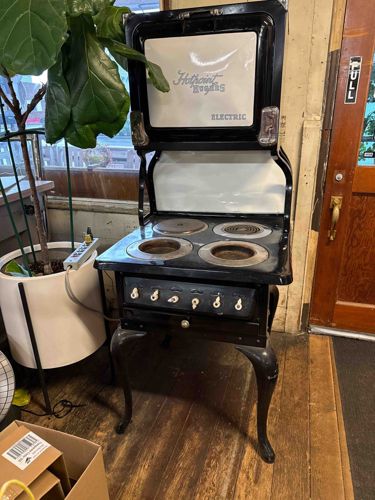
1923 Hotpoint Hughes Electric Range

Antique Appliances / Kitchenware

AI Estimated Value

·Not an official valuation·Verify before acting

$1,800 - $2,500

As of May 23, 2026

AI Item Analysis

·AI can make mistakes·Verify before acting
This is a significant early 20th-century appliance, specifically a Hotpoint Hughes Electric Range dating to approximately 1923. The unit is a multi-tiered freestanding stove featuring a cast iron and sheet metal body finished in a high-gloss black porcelain enamel, contrasted with white porcelain enamel panels on the oven door and backguard. The front of the oven door is prominently labeled with the 'Hotpoint Hughes ELECTRIC' branding in a period-appropriate stylized script. The range stands on four elegant, slender cabriole-style legs, which are characteristic of the transition into more decorative home appliances during the early electric era. The cooktop surface contains four circular electric heating elements with metallic ring surrounds. Below the cooktop is a control panel featuring seven distinct white ceramic or porcelain toggle-style switches arranged horizontally, used for adjusting heat levels for the burners and oven. The condition appears well-preserved for its age, showing a deep patina and minor surface wear typical for a hundred-year-old appliance. There are visible signs of aging on the heating elements and some minor dulling of the chrome or nickel-plated hardware. The white enamel back panel and oven door appear remarkably intact without significant chipping, which is often a point of value for collectors. This model represents the collaboration between George Hughes, who invented the electric range, and the Hotpoint brand, marking a pivotal moment in domestic kitchen history.
AI Appraisal Report

·AI can make mistakes·Verify before acting
I have examined the images of this 1923 Hotpoint Hughes Electric Range. The piece is a quintessential example of early 20th-century industrial design, representing the pivotal merger between George Hughes’ cooking technology and the Hotpoint brand. Authenticity appears consistent with the period, evidenced by the specific 'Hotpoint Hughes' script, the transition-era cabriole legs, and the ceramic toggle switches. The condition is remarkable; the high-gloss black and white porcelain enamel shows minimal 'spidering' or chipping, which is the primary driver of value in this category. While the heating elements show expected oxidation, the integrity of the nickel-plated hardware remains high. In the current market, early electric ranges are highly sought after by 'industrial chic' collectors and museum curators. Comparables for restored models often exceed $4,000, but in this well-preserved original state, the value remains strong for collectors who prefer 'survivor' condition. The rarity is noted in the intact condition of the white enamel backguard, which frequently breaks during transport. Major value factors include the presence of all seven original switches and the legible branding. However, this visual appraisal is limited. I cannot verify the internal wiring safety, the functionality of the heating coils, or the presence of non-visible structural rust. A full physical authentication would require a continuity test of the electrical system, a check for porcelain repairs using UV light, and documentation of provenance to confirm it hasn't been subjected to an amateur cosmetic restoration.

Get your items appraised

Instant estimates of your treasures with AI-powered appraisals

Browse More Appraisals