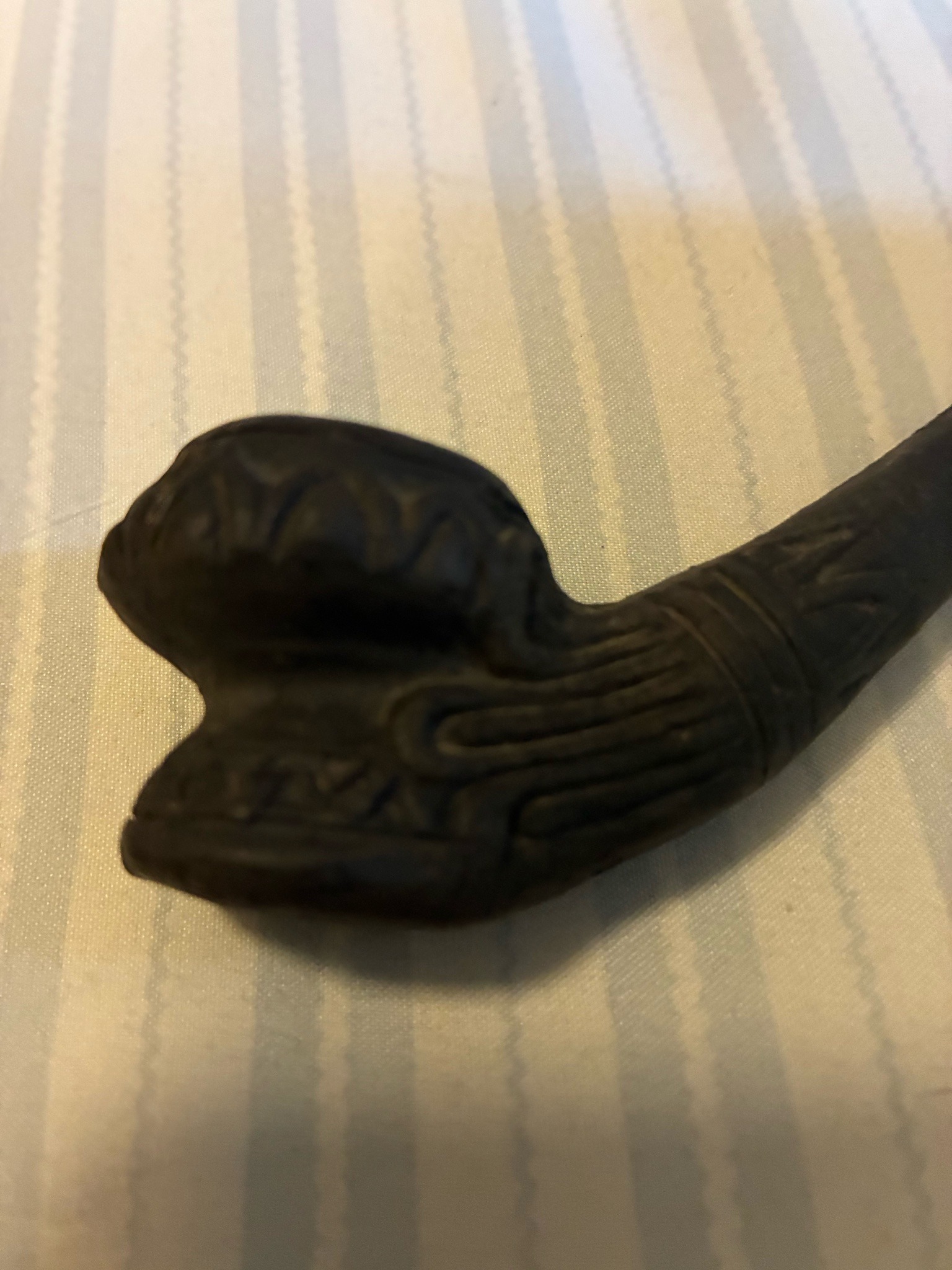
Pre-Columbian Style Effigy Tobacco Pipe
This is a hand-formed ceramic or clay tobacco pipe, likely modeled after Pre-Columbian or Mesoamerican artifacts. The item exhibits a dark, charcoal-grey to black finish, potentially achieved through a reduction-firing process or by rubbing the surface with graphite or soot. The pipe features a prominent bowl transitioning into a slightly curved stem. The exterior surface is elaborately decorated with hand-incised geometric and zoomorphic patterns, including wavy lines, chevrons, and nested U-shapes that suggest a stylized reptilian or avian head. These decorative elements are deeply carved, showing a high level of folk-art craftsmanship. There is evidence of significant surface accumulation, likely dust or soil from long-term storage in a root cellar, interspersed with a matte patina that develops with age. The condition appears structurally sound with no major cracks visible in the primary image, though the surface shows uneven wear and variations in the dark pigmentation. Given the finding location and history, this piece most likely dates from the late 19th to mid-20th century, serving as either a utilitarian smoking implement or a historical reproduction aimed at the early American curio market.

AI-Generated Appraisal Disclaimer
Estimated Value
$150 - $350
Basic Information
Category
Antiques & Artifacts - Ethnographic Collectibles
Appraised On
April 25, 2026
Estimated Value
$150 - $350
Additional Details Provided By Owner
User Provided Information
Found mysteriously in the root cellar of 50 years. In Colorado Springs CO
Item Description
This is a hand-formed ceramic or clay tobacco pipe, likely modeled after Pre-Columbian or Mesoamerican artifacts. The item exhibits a dark, charcoal-grey to black finish, potentially achieved through a reduction-firing process or by rubbing the surface with graphite or soot. The pipe features a prominent bowl transitioning into a slightly curved stem. The exterior surface is elaborately decorated with hand-incised geometric and zoomorphic patterns, including wavy lines, chevrons, and nested U-shapes that suggest a stylized reptilian or avian head. These decorative elements are deeply carved, showing a high level of folk-art craftsmanship. There is evidence of significant surface accumulation, likely dust or soil from long-term storage in a root cellar, interspersed with a matte patina that develops with age. The condition appears structurally sound with no major cracks visible in the primary image, though the surface shows uneven wear and variations in the dark pigmentation. Given the finding location and history, this piece most likely dates from the late 19th to mid-20th century, serving as either a utilitarian smoking implement or a historical reproduction aimed at the early American curio market.

Get Your Items Appraised
Instant estimates of your treasures with AI-powered instant appraisals