AI estimate as of September 27, 2025 · verify with a professional before acting
AI-Generated · Verify before acting
Everything on this page is generated by AI for informational purposes only. AI can make mistakes — the AI may misidentify items or misattribute them (artist, maker, brand, designer, origin, era). This is not an official valuation and should not be used for insurance, sale, tax, estate, legal, or lending purposes — or any decision requiring a certified appraisal. It is not an authoritative claim about any person, brand, or rights holder — do not share or rely on it as a factual statement about a third party. Always consult qualified professionals before making financial decisions.
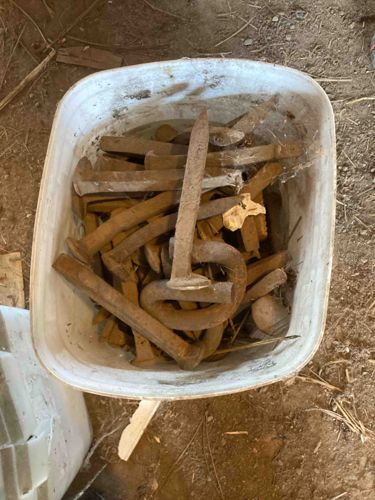
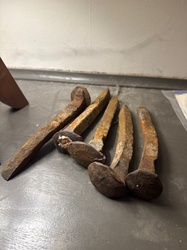
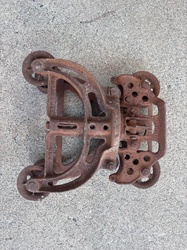
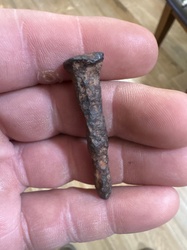
This image displays a collection of assorted, heavily rusted iron objects contained within a dirty, white or light-colored plastic bucket or tray. The primary identifiable items are antique railroad spikes, characterized by their robust, square-shank bodies tapering to a point and their flat, broad heads designed for securing rails to ties. There appear to be multiple variations in size among the spikes, though precise dimensions are difficult to ascertain from the image. Some pieces exhibit the distinctive L-shape prevalent in rail spikes. The material is clearly iron or steel, given the pervasive and advanced state of reddish-brown rust covering every surface. This heavy oxidation indicates significant exposure to moisture and air over an extended period. The overall condition suggests that these items are salvaged, potentially from decommissioned railway lines or demolition sites, rather than being new or recently manufactured. There are no discernible maker's marks, signatures, or stamps visible through the thick layer of rust. The style and construction firmly place these items within the era of early to mid-20th-century or even late 19th-century railway construction. Quality indicators are difficult to assess due to the wear, but the original construction would have been utilitarian and robust, designed for heavy industrial use. The presence of cobwebs and a piece of organic debris (possibly a dried leaf or wood splinter) within the bucket further reinforces the impression of long-term storage in an outdoor or semi-sheltered, dusty environment. This collection is notable for its historical context rather than its current functional utility.
AI Appraisal Report
I have examined the provided image of an assorted collection of antique railroad spikes and other iron hardware. The condition of these items is heavily rusted, consistent with long-term exposure to the elements. Authenticity, based on visual cues, appears genuine for antique railroad spikes, exhibiting characteristic forms and heavy oxidation. However, without in-person inspection, I cannot confirm material composition (iron vs. steel) or rule out modern reproductions distressed to appear aged. There are no visible maker's marks or distinguishing features that would indicate rare origins.
The market for salvaged railroad spikes is generally niche. Comparables typically involve individual spikes or small lots sold at antique malls, flea markets, or online platforms. While they possess historical charm, the demand is moderate, driven primarily by DIY decorators, railroad enthusiasts, or those seeking industrial-style decor. Rarity is low; hundreds of thousands, if not millions, of such spikes were produced and many still exist as salvage. The value is significantly impacted by the quantity, condition (heavy rust reduces value for some, adds authenticity for others), and lack of any unique identifying features. Without provenance, these are generic historical artifacts.
To fully authenticate and assess potential rarity, an in-person examination would be crucial to inspect for unique forge marks, exact dimensions, and metallurgical analysis. Provenance documentation, such as records indicating their origin from a specific historic railway line, would significantly increase their value. As they stand, this is a collection of common salvage hardware.