AI estimate as of July 31, 2025 · verify with a professional before acting
AI-Generated · Verify before acting
Everything on this page is generated by AI for informational purposes only. AI can make mistakes — the AI may misidentify items or misattribute them (artist, maker, brand, designer, origin, era). This is not an official valuation and should not be used for insurance, sale, tax, estate, legal, or lending purposes — or any decision requiring a certified appraisal. It is not an authoritative claim about any person, brand, or rights holder — do not share or rely on it as a factual statement about a third party. Always consult qualified professionals before making financial decisions.
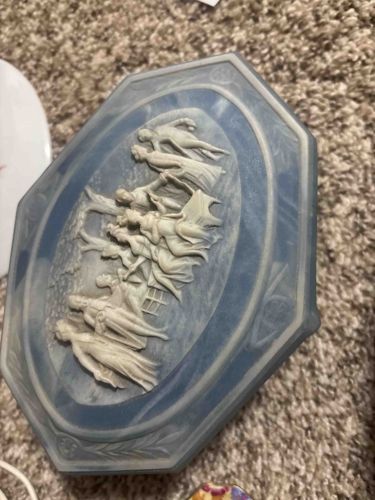
This item is an octagonal decorative plate or plaque, likely made from Jasperware, characterized by its distinctive matte, unglazed ceramic. The primary color of the plate is a soft, muted blue, often referred to as 'Wedgwood blue,' which has a subtle marbling or clouding effect visible across its surface. This blue serves as the background for the raised, unglazed white bas-relief figures. The central motif depicts a classical scene, with multiple draped human figures, likely goddesses or nymphs, in various dynamic poses. One can discern flowing drapery, subtle anatomical details, and a sense of movement among the figures. The craftsmanship of the figures suggests a high level of detail, typical of fine ceramic artistry. Surrounding the central relief, there is an oval-shaped border that frames the scene. The outer, octagonal rim of the plate features a delicate, raised decorative pattern, possibly a vine or foliate design, enhancing its classical aesthetic. The overall condition appears good, with no immediately visible chips, cracks, or significant damage, though some light surface dust or patina is present, consistent with age and display. The matte finish inherently shows less direct wear than glazed items, but subtle rubbing could occur on the raised white areas over time. The item's style, material, and coloration strongly suggest it is a piece of Jasperware, a type of stoneware first developed by Josiah Wedgwood in the 1770s, making its estimated age capable of spanning from the late 18th century to modern reproductions. Without visible maker's marks, specific attribution is difficult, but the quality of the relief and the characteristic blue body indicate a piece made with attention to detail and traditional manufacturing techniques.
AI Appraisal Report
Upon visual examination, this octagonal plate presents as a fine example of Jasperware, characterized by its distinctive 'Wedgwood blue' matte body and applied white bas-relief decoration. The craftsmanship of the central classical scene and the surrounding foliate border is of high quality, showing intricate detail in the figures and drapery. The piece appears to be in very good condition, with no visible chips, cracks, or restorations, though a light patina consistent with age is noted. The primary factor limiting its value is the lack of a visible maker's mark. While the style and quality are strongly reminiscent of Wedgwood, it could also be a high-quality piece by a contemporary competitor like Adams or a later reproduction. Without definitive attribution, its value is benchmarked against comparable, unsigned Jasperware plaques. The market for unsigned Jasperware is stable but commands a lower price than marked Wedgwood pieces. Demand remains steady amongst collectors of classical-style ceramics. A full authentication would require in-person examination to search for impressed marks, which are often faint, and to assess the texture and weight, which are key indicators of true 18th or 19th-century Jasperware. Provenance documentation would be essential for confirming a specific maker or period.