These notes were written by the person who submitted this item. Appraiser.AI has not verified them, and the AI's identification and estimate may rely on them.
AI Estimated Value
Not an official valuation
$300-500
AI estimate as of June 24, 2025 · verify with a professional before acting
AI-Generated · Verify before acting
Everything on this page is generated by AI for informational purposes only. AI can make mistakes — the AI may misidentify items or misattribute them (artist, maker, brand, designer, origin, era). This is not an official valuation and should not be used for insurance, sale, tax, estate, legal, or lending purposes — or any decision requiring a certified appraisal. It is not an authoritative claim about any person, brand, or rights holder — do not share or rely on it as a factual statement about a third party. Always consult qualified professionals before making financial decisions.
This analysis also relies on unverified notes provided by the user, which may be incomplete or inaccurate and could affect the result.
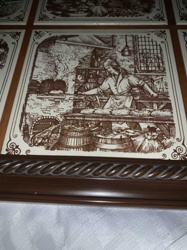
This appears to be a large, rectangular decorative ceramic tile or plaque, possibly intended as a tabletop insert, wall hanging, or part of a larger furnishing like a planter or lamp base as suggested by the context. The primary colors are a light, pale blue (almost celadon or duck egg blue) for the background and a rich, reddish-brown for the detailed ornamentation, reminiscent of sepia or iron red transferware. The surface exhibits a glossy finish, likely a glaze, which reflects light, indicating it is ceramic or porcelain. The decorative motif is an elaborate chinoiserie landscape, featuring fantastical birds (possibly hummingbirds or similar passerines) in flight and perched among stylized floral and leafy branches. Below, a whimsical mountainous terrain incorporates architectural elements resembling pagodas or oriental castles with multiple spires. In the foreground, a detailed scene depicts a figure, possibly human or mythical, engaging with a quadruped animal, perhaps a deer or goat, amidst large, structured foliage and rocky outcrops. The entire design has a dreamlike and intricate quality, typical of 18th or 19th-century European interpretations of Asian art. The brown color of the decoration is consistent and well-applied, suggesting either hand-painting with a high degree of skill or a very precise transfer-printing technique. There are no immediate visible signs of major damage such as chips, cracks, or significant abrasions from the provided image, though the glossy surface makes it difficult to ascertain minor imperfections like crazing or faint scratches. The edges of the plaque appear to have a solid brown border, framing the central design. The overall craftsmanship suggests a piece of good quality, likely produced in Europe, possibly France or England, given the chinoiserie style's popularity during the Rococo or Georgian periods. Its substantial size implies it was a significant decorative element.
AI Appraisal Report
Upon examining the images, this item is a large and highly decorative European ceramic plaque, executed in the Chinoiserie style. The piece features a detailed iron red or sepia transfer-printed design on a pale blue ground, depicting an intricate landscape with birds, figures, and architectural follies. Its intended use was likely as an inset for a piece of furniture, such as a jardiniere, fire screen, or the body of a large lamp, consistent with high-end decorative arts of the late 19th or early 20th century. Visually, the plaque appears to be in excellent condition, with a strong gloss and no readily apparent chips, cracks, or repairs. The market for such decorative plaques is steady. As a standalone element removed from its original context, its value is primarily decorative. Comparables are often found in the low-to-mid hundreds, depending on the quality and manufacturer. The primary factor limiting the value is its status as a component part. A complete, marked planter by a known maker like Sèvres or a Napoleon III-era furniture guild would be worth substantially more. Authentication from images alone is impossible. A physical examination is required to inspect the reverse for any impressed or printed maker's marks, which would be critical for attribution and precise dating. Furthermore, examining the ceramic body and looking for wear under magnification would help confirm its age and distinguish it from more recent reproductions.