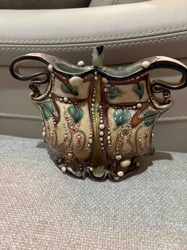
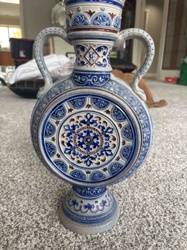
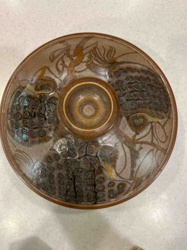
200 * years old. Carried in Revolution War to hold brandy.
These notes were written by the person who submitted this item. Appraiser.AI has not verified them, and the AI's identification and estimate may rely on them.
AI Estimated Value
Not an official valuation
$600 - $1,200
AI estimate as of November 30, 2025 · verify with a professional before acting
AI-Generated · Verify before acting
Everything on this page is generated by AI for informational purposes only. AI can make mistakes — the AI may misidentify items or misattribute them (artist, maker, brand, designer, origin, era). This is not an official valuation and should not be used for insurance, sale, tax, estate, legal, or lending purposes — or any decision requiring a certified appraisal. It is not an authoritative claim about any person, brand, or rights holder — do not share or rely on it as a factual statement about a third party. Always consult qualified professionals before making financial decisions.
This analysis also relies on unverified notes provided by the user, which may be incomplete or inaccurate and could affect the result.
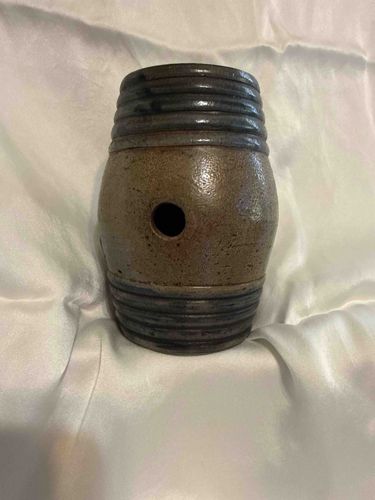
This appears to be an antique stoneware canteen, sometimes referred to as a brandy keg, characterized by its barrel-like, ovoid form. It is crafted from a gritty, salt-glazed stoneware, exhibiting a mottled grey and brown coloration with visible darker speckles, indicative of impurities in the clay and the firing process. The body tapers slightly towards the top and bottom. A distinctive feature includes several incised rings or grooves encircling the top and bottom sections, imitating the hoops of a wooden barrel, which are glazed a darker, almost blackish-blue hue, providing a subtle contrast to the lighter central body. A single, prominent circular opening, likely a pouring spout or bung hole, is located on one side of the central body. The surface shows a slightly glossy finish, typical of salt glaze, which also contributes to its durability. The overall condition suggests significant age; there is a visible, well-worn patina, consistent with the provided context of being 200 years old and used during the Revolutionary War. While no specific maker's marks or signatures are discernable from the image, the rustic craftsmanship and material are characteristic of utilitarian stoneware produced in early America. Its robust construction and practical design suggest it was built for frequent use and resilience. The lack of chips or significant cracks, despite its age and purported history, speaks to the inherent strength of stoneware. Its unique aspect is the strong historical provenance, suggesting it was carried during the American Revolutionary War. This item reflects a period when pottery was functional and often quite artistic in a rustic way.
AI Appraisal Report
I have examined the provided image of this Early American Stoneware Canteen (Brandy Keg). The item presents as a well-preserved example of salt-glazed stoneware, consistent with utilitarian pottery produced in the late 18th to early 19th century in America. The ovoid, barrel-like form and incised 'hoop' decoration are characteristic. The mottled grey-brown coloration with darker speckles and 'blackish-blue' glazed rings align with typical salt-glaze firing anomalies and decorative techniques of the period. The condition appears to be very good, with no obvious chips or cracks visible, which is remarkable for an item of this purported age. The surface exhibits a desirable patina. Based on visual assessment, the craftsmanship and material are authentic for early American stoneware. While the item itself appears genuine for its type and age, the significant historical provenance – 'carried in the Revolutionary War to hold brandy' and '200 years old' (placing it circa 1820, post-Revolutionary War) – cannot be verified from images alone. A 200-year age aligns more with the War of 1812 period than the Revolution, though similar forms existed earlier. The market for early American utilitarian stoneware is stable, with strong demand for well-preserved, authentic pieces. Items with verifiable historical provenance, such as Revolutionary War usage, command a premium, often significantly increasing value. However, without concrete documentation – such as period receipts, family lore, or an archaeological context – connecting this specific canteen to the Revolutionary War, it must be appraised primarily as a fine example of early American stoneware. Its rarity lies in its excellent condition and the classic form. An in-person examination would be critical to confirm authenticity, assess any repairs or hidden damages, and potentially identify faint maker's marks. Furthermore, robust provenance documentation, or even scientific dating techniques, would be required to authenticate the Revolutionary War claim. Without such verification, the 'Revolutionary War' association adds speculative rather than confirmed value.