AI Appraisal Estimate

AI-generated estimates · not official valuations

From the user

What was submitted

Photo and notes provided by the user — not generated by AI

Submitted item photo
Submitted photo · June 15, 2026

User's notes

No additional notes provided.

AI analysis below

AI appraisal

AI analysis & estimate

AI-Generated · Verify before acting

Everything below is generated by AI for informational purposes only. AI can make mistakes — the AI may misidentify items or misattribute them (artist, maker, brand, designer, origin, era). This is not an official valuation and should not be used for insurance, sale, tax, estate, legal, or lending purposes — or any decision requiring a certified appraisal. It is not an authoritative claim about any person, brand, or rights holder — do not share or rely on it as a factual statement about a third party. Always consult qualified professionals before making financial decisions.

Read the full disclaimer

AI Identification

·Not independently authenticated·Verify before acting

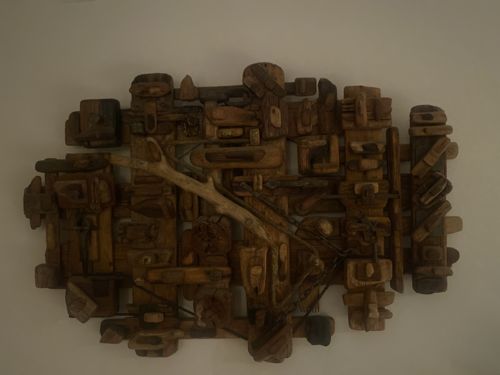
Mid-Century Brutalist Abstract Reclaimed Wood Wall Relief

Fine Art - Sculpture / Wall Relief

AI Estimated Value

·Not an official valuation·Verify before acting

$2,500 - $3,800

As of June 15, 2026

AI Item Analysis

·AI can make mistakes·Verify before acting
This is a large-scale, multi-dimensional wall-hanging relief sculpture crafted in the Brutalist style, likely dating from the 1960s to the 1970s. The piece is constructed from meticulously arranged fragments of reclaimed wood, including dimensional lumber offcuts, various geometric blocks, and naturally weathered organic elements. A prominent sun-bleached driftwood branch or piece of light-toned root wood is layered across the center, providing a stark organic contrast to the dense, rectilinear composition of the background. The color palette is composed of varied natural wood tones ranging from deep charcoal and umber to golden honey and pale tan, suggesting the use of multiple wood species or varying degrees of weathering and staining. The construction features complex layering and overlapping, creating significant physical depth and a play of shadow. Visible condition is consistent with age, showing a natural matte patina, minor abrasions, and accumulated dust in the deep crevices. No maker's marks are visible from the front; however, the sophisticated vertical and horizontal interlocking grid structure indicates professional craftsmanship. This type of 'found object' abstraction was popularized by artists like Louise Nevelson and Paul Evans, emphasizing texture, industrial decay, and raw architectural form. The piece appears structurally sound, though the delicate nature of the thin wood joints requires careful handling.
AI Appraisal Report

·AI can make mistakes·Verify before acting
Based on my visual examination of this Mid-Century Brutalist wall relief, I assess the piece to be a high-quality example of 1960s–1970s organic abstraction. The craftsmanship is sophisticated, utilizing a complex interlocking grid of reclaimed lumber and found driftwood that mirrors the heavy, textural aesthetic popularized by Paul Evans and Louise Nevelson. The juxtaposition of geometric offcuts with scorched or weathered organic elements is highly characteristic of the period's interest in 'industrial-natural' synthesis. The condition appears remarkably consistent with its age, exhibiting a desirable matte patina and minor age-related abrasions that do not detract from the aesthetic value. The market for large-scale Brutalist wall art remains robust, specifically in the interior design sector where such pieces serve as focal points. Comparable works from unidentified but skilled craftsmen typically command mid-four-figure prices, whereas a confirmed signature from an artist like Jere or a regional master would significantly escalate value. Limitations: My assessment is based solely on high-resolution imagery. Without a physical inspection, I cannot verify the integrity of the internal joinery or identify potential wood-pest damage. Full authentication would require an in-person examination to locate an obscured maker’s mark or signature, often found on the reverse or integrated into the lower edge. Additionally, provenance documentation (e.g., original gallery receipts or exhibition history) would be necessary to elevate the piece from 'style of' to 'attributed to' a specific artist. A tactile review of the wood's density and weight would also confirm if the specimen uses domestic hardwoods or more exotic varieties from the era.

Get your items appraised

Instant estimates of your treasures with AI-powered appraisals

Browse More Appraisals